Skip to main content
Organic Chemistry
나의 코스
배우기
시험 준비
AI 튜터
학습 가이드
교과서적 해결책
플래시카드
탐험해 보세요
앱을 사용해 보세요
나의 코스
배우기
시험 준비
AI 튜터
학습 가이드
교과서적 해결책
플래시카드
탐험해 보세요
앱을 사용해 보세요
뒤로
pKa definitions
카드를 뒤집기 위해 탭할 수 있습니다.
pKa
카드를 뒤집기 위해 탭할 수 있습니다.
👆
pKa
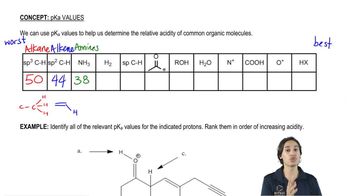
Numerical value indicating acid strength; lower numbers mean stronger acids, higher numbers mean weaker acids.
진행 상황 추적
컨트롤 버튼이 '내비게이션' 모드로 변경되었습니다.
1/14
관련 플래시카드
관련 실천
추천 영상
pKa quiz
pKa Values
10 용어
pKa quiz #1
pKa Values
10 용어
pKa
3. Acids and Bases
6 문제점
주제
Johnny
Acid Base Equilibrium
3. Acids and Bases
7 문제점
주제
Johnny
3. Acids and Bases - Part 1 of 2
4 주제
10 문제점
장
Laura
3. Acids and Bases - Part 2 of 2
3 주제
9 문제점
장
Johnny
07:45
Identifying pKa values
4032
views
28
rank
12
comments
09:36
The 12 pKa values you want to memorize (because they are important!).
5521
views
37
rank
12
comments
이 집합의 용어 (14)
하이드의 정의
pKa
Numerical value indicating acid strength; lower numbers mean stronger acids, higher numbers mean weaker acids.
Alkane
Hydrocarbon with only single bonds and sp3 hybridized carbons; exhibits very low acidity with a pKa around 50.
Alkene
Hydrocarbon containing at least one double bond with sp2 hybridized carbons; has a pKa near 44.
Alkyne
Hydrocarbon featuring a triple bond and sp hybridized carbons; more acidic than alkanes and alkenes, with a pKa of 25.
Amine
Compound with a nitrogen atom bonded to hydrogens or carbons; has a pKa of 38, indicating weak acidity.
Diatomic Hydrogen
Molecule consisting of two hydrogen atoms (H2); has a pKa of 35, slightly more acidic than alkanes.
Alpha Hydrogen
Hydrogen atom attached to the carbon adjacent to a carbonyl group; notably more acidic due to tautomerization, with a pKa of 20.
Tautomerization
Process that increases acidity of hydrogens next to carbonyls by stabilizing the conjugate base through resonance.
Alcohol
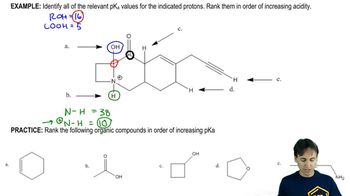
Organic compound with a hydroxyl group (–OH) attached to a carbon; has a pKa around 16, serving as a reference point.
Water
Universal solvent with a pKa of about 16, used as a midpoint for comparing acid strengths.
Carboxylic Acid
Organic acid containing a carboxyl group (–COOH); strong acid with a pKa near 5, exemplified by acetic acid.
Acetic Acid
Simple carboxylic acid with a pKa of approximately 4.75, often used as a reference for strong organic acids.
Electrophilicity
Tendency of a species to attract electrons, often increased by positive charges, enhancing acid strength.
Strong Acid
Substance with a very low or negative pKa, such as HCl, HBr, or HI, indicating high proton-donating ability.
 뒤로뒤로
뒤로뒤로

 07:45
07:45