Skip to main content
Organic Chemistry
나의 코스
배우기
시험 준비
AI 튜터
학습 가이드
교과서적 해결책
플래시카드
탐험해 보세요
앱을 사용해 보세요
나의 코스
배우기
시험 준비
AI 튜터
학습 가이드
교과서적 해결책
플래시카드
탐험해 보세요
앱을 사용해 보세요
뒤로
Radical Reaction definitions
카드를 뒤집기 위해 탭할 수 있습니다.
Radical
카드를 뒤집기 위해 탭할 수 있습니다.
👆
Radical
A high-energy, short-lived species with an unpaired electron, crucial as an intermediate in specific organic mechanisms.
진행 상황 추적
컨트롤 버튼이 '내비게이션' 모드로 변경되었습니다.
1/15
관련 플래시카드
관련 실천
추천 영상
Radical Reaction quiz #1
Radical Initiators
10 용어
Radical Synthesis
11. Radical Reactions
7 문제점
주제
Ernest
Radical Stability
11. Radical Reactions
7 문제점
주제
Ernest
11. Radical Reactions - Part 1 of 2
4 주제
11 문제점
장
Johnny
11. Radical Reactions - Part 2 of 2
5 주제
13 문제점
장
Johnny
03:49
What are Radical Initiators?
3941
views
71
rank
6
comments
04:39
Heterolytic vs. Homolytic Bond Cleavage .
4927
views
77
rank
5
comments
이 집합의 용어 (15)
하이드의 정의
Radical
A high-energy, short-lived species with an unpaired electron, crucial as an intermediate in specific organic mechanisms.
Radical Initiator
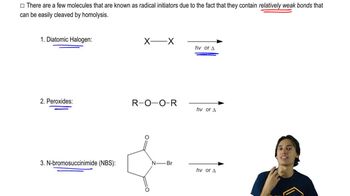
A compound with a weak bond that, upon exposure to heat or light, generates the first radical needed to start a chain reaction.
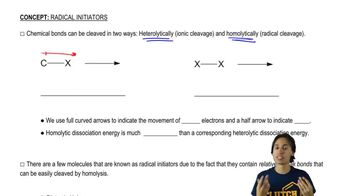
Homolytic Cleavage
A bond-breaking process where each atom receives one electron, resulting in two radicals with equal charge.
Heterolytic Cleavage
A bond-breaking process where both electrons move to one atom, producing a cation and an anion.
Diatomic Halogen
A molecule consisting of two identical halogen atoms, often used as a source of radicals due to its weak bond.
Peroxide
A compound containing an O–O bond, notable for its weak linkage and frequent use as a radical initiator.
N-Bromosuccinimide
A reagent with a weak N–Br bond, commonly used to generate bromine radicals in organic reactions.
Cation
A positively charged ion formed when an atom loses electrons during heterolytic cleavage.
Anion
A negatively charged ion formed when an atom gains electrons during heterolytic cleavage.
Dissociation Energy
The energy required to break a specific bond, with homolytic processes typically needing more than heterolytic ones.
Fish Hook Arrow
A curved arrow with a single head, used in mechanisms to indicate the movement of one electron.
Curved Arrow
A notation in reaction mechanisms showing the movement of electron pairs, typically with a full arrowhead.
Electronegativity
A property describing an atom's tendency to attract electrons, influencing the outcome of bond cleavage.
Intermediate
A transient species formed during a reaction, often highly reactive and short-lived, such as a radical.
Ultraviolet Light
A form of energy commonly used to initiate homolytic cleavage in radical reactions by exciting electrons.
 뒤로뒤로
뒤로뒤로

 03:49
03:49