Skip to main content
Organic Chemistry
나의 코스
배우기
시험 준비
AI 튜터
학습 가이드
교과서적 해결책
플래시카드
탐험해 보세요
앱을 사용해 보세요
나의 코스
배우기
시험 준비
AI 튜터
학습 가이드
교과서적 해결책
플래시카드
탐험해 보세요
앱을 사용해 보세요
뒤로
Rates of Intramolecular Reactions definitions
카드를 뒤집기 위해 탭할 수 있습니다.
Intramolecular Reaction
카드를 뒤집기 위해 탭할 수 있습니다.
👆
Intramolecular Reaction
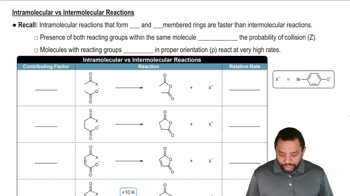
A process where reacting groups within a single molecule interact, leading to higher reaction rates due to increased collision probability.
진행 상황 추적
컨트롤 버튼이 '내비게이션' 모드로 변경되었습니다.
1/15
관련 플래시카드
관련 실천
추천 영상
Rates of Intramolecular Reactions quiz
Rates of Intramolecular Reactions
15 용어
Rates of Intramolecular Reactions
31. Catalysis in Organic Reactions
5 문제점
주제
Intramolecular Acid-Base Catalysis
31. Catalysis in Organic Reactions
5 문제점
주제
31. Catalysis in Organic Reactions - Part 1 of 2
4 주제
12 문제점
장
31. Catalysis in Organic Reactions - Part 2 of 2
4 주제
12 문제점
장
VideoThumbView.guidedCourse
2:29
Rates of Intramolecular Reactions Concept 1
266
views
VideoThumbView.guidedCourse
5:07
Rates of Intramolecular Reactions Concept 2
272
views
VideoThumbView.guidedCourse
2:02
Rates of Intramolecular Reactions Example 1
289
views
이 집합의 용어 (15)
하이드의 정의
Intramolecular Reaction
A process where reacting groups within a single molecule interact, leading to higher reaction rates due to increased collision probability.
Intermolecular Reaction
A process involving interactions between separate molecules, typically resulting in slower reaction rates.
Rate Constant
A proportionality factor (k) in the rate equation, influenced by activation energy, temperature, and molecular collisions.
Activation Energy
The minimum energy required for reactants to successfully transform into products during a chemical reaction.
Frequency Factor
A component (A) in the Arrhenius equation, representing the product of collision frequency and orientation factor.
Collision Frequency
The number of times reactant molecules encounter each other per second, impacting the likelihood of reaction.
Orientation Factor
A measure of how favorably molecules are aligned during collisions, affecting the probability of a successful reaction.
Relative Rate
A comparison of reaction speeds under different conditions, highlighting the influence of molecular structure and environment.
Ring Formation
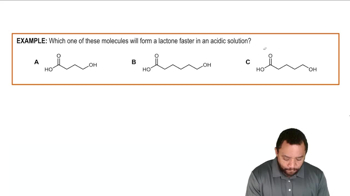
The creation of cyclic structures, especially 5 or 6-membered rings, which significantly accelerates reaction rates.
Temperature
A variable that, when increased by 10 Kelvin, can approximately double the rate of a chemical reaction.
Gas Constant
A physical constant (R) used in kinetic equations, relating energy scale to temperature and amount of substance.
Kelvin
The SI unit for temperature, crucial for expressing thermal energy in reaction rate calculations.
Pi Bond
A type of covalent bond that restricts rotation, locking groups in place and enhancing orientation for reactions.
Chain Length
The number of atoms in a molecular backbone, which can alter the rate and outcome of intramolecular reactions.
Leaving Group
An atom or group that departs from a molecule during a reaction, influencing the reaction's mechanism and rate.
 뒤로뒤로
뒤로뒤로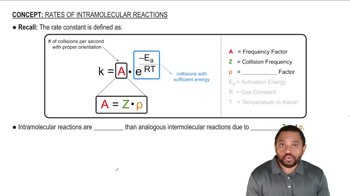
 2:29
2:29