Skip to main content
Organic Chemistry
나의 코스
배우기
시험 준비
AI 튜터
학습 가이드
교과서적 해결책
플래시카드
탐험해 보세요
앱을 사용해 보세요
나의 코스
배우기
시험 준비
AI 튜터
학습 가이드
교과서적 해결책
플래시카드
탐험해 보세요
앱을 사용해 보세요
뒤로
Solvents definitions
카드를 뒤집기 위해 탭할 수 있습니다.
Solvent
카드를 뒤집기 위해 탭할 수 있습니다.
👆
Solvent
An inert compound serving as a medium for reactions, typically shown below the reaction arrow and not directly involved in the mechanism.
진행 상황 추적
컨트롤 버튼이 '내비게이션' 모드로 변경되었습니다.
1/15
관련 플래시카드
관련 실천
추천 영상
Solvents quiz #1
Solvents
10 용어
Solvents
8. Elimination Reactions
4 문제점
주제
Ernest
Leaving Groups
8. Elimination Reactions
5 문제점
주제
Ernest
8. Elimination Reactions - Part 1 of 3
5 주제
11 문제점
장
Johnny
8. Elimination Reactions - Part 2 of 3
5 주제
13 문제점
장
Ernest
8. Elimination Reactions - Part 3 of 3
1 주제
3 문제점
장
03:57
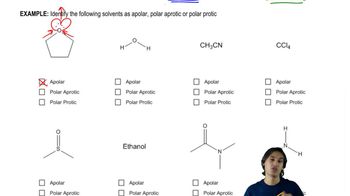
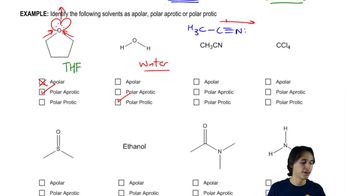
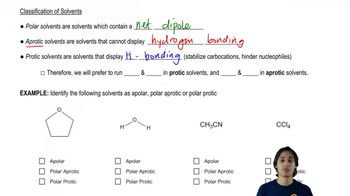
The difference between protic vs. aprotic solvents.
4533
views
38
rank
9
comments
01:16
Identification of polarity in solvents
3381
views
33
rank
3
comments
00:39
Identification of polarity in solvents
2983
views
27
rank
2
comments
이 집합의 용어 (15)
하이드의 정의
Solvent
An inert compound serving as a medium for reactions, typically shown below the reaction arrow and not directly involved in the mechanism.
Polar Solvent
A molecule with a net dipole, influencing reaction environments by stabilizing charged intermediates.
Protic Solvent
A compound capable of hydrogen bonding, often containing O, N, or F, which stabilizes carbocations and slows nucleophiles.
Aprotic Solvent
A compound unable to hydrogen bond, allowing nucleophiles to react freely without hindrance.
Hydrogen Bonding
An interaction where a hydrogen atom is shared between electronegative atoms, crucial for protic solvent behavior.
Carbocation Stabilization
The effect where certain media reduce the energy of positively charged intermediates, favoring specific mechanisms.
Nucleophile
A species with a negative charge or lone pair, seeking to donate electrons, whose reactivity is influenced by the surrounding medium.
Leaving Group
A fragment that departs with a pair of electrons during a reaction, its importance often outweighing that of the medium.
SN1 Mechanism
A substitution pathway involving carbocation formation, favored by environments that stabilize positive charges.
SN2 Mechanism
A substitution pathway requiring unhindered nucleophiles, best performed in media that do not slow them down.
E1 Mechanism
An elimination pathway involving carbocation intermediates, promoted by environments that stabilize positive charges.
E2 Mechanism
An elimination pathway requiring strong nucleophiles, favored by media that do not hinder their movement.
Reaction Arrow
A notation in chemical equations, with the medium typically indicated below and the active reagent above.
Dipole
A separation of charge within a molecule, determining whether a medium is classified as polar.
Medium
The environment in which a chemical process occurs, often provided by an inert compound.
 뒤로뒤로
뒤로뒤로

 03:57
03:57