Organic Chemistry
나의 코스
배우기
시험 준비
AI 튜터
학습 가이드
교과서적 해결책
플래시카드
탐험해 보세요
앱을 사용해 보세요
나의 코스
배우기
시험 준비
AI 튜터
학습 가이드
교과서적 해결책
플래시카드
탐험해 보세요
앱을 사용해 보세요
뒤로
Step-Growth Polymers: Epoxy Resin quiz
카드를 뒤집기 위해 탭할 수 있습니다.
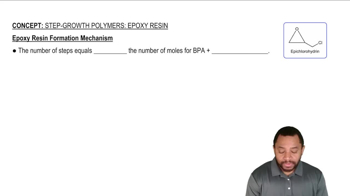
What is the formula for determining the number of steps in the epoxy resin formation mechanism?
카드를 뒤집기 위해 탭할 수 있습니다.
👆
What is the formula for determining the number of steps in the epoxy resin formation mechanism?
The number of steps equals twice the number of moles of BPA plus a protonation step.
진행 상황 추적
컨트롤 버튼이 '내비게이션' 모드로 변경되었습니다.
1/15
관련 플래시카드
추천 영상
Step-Growth Polymers: Epoxy Resin definitions
Step-Growth Polymers: Epoxy Resin
13 용어
00:52
Step-Growth Polymers: Epoxy Resin Concept 1
711
views
4:30
Step-Growth Polymers: Epoxy Resin Example 1
732
views
이 집합의 용어 (15)
하이드의 정의
What is the formula for determining the number of steps in the epoxy resin formation mechanism?
The number of steps equals twice the number of moles of BPA plus a protonation step.
What is epichlorohydrin in the context of epoxy resin formation?
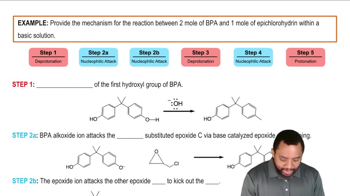
Epichlorohydrin is an epoxide ring attached to a methylene group (CH2) and a chlorine atom (Cl).
Which two key molecules are involved in the formation of epoxy resins?
The key molecules are epichlorohydrin and bisphenol A (BPA).
What role does BPA play in the epoxy resin formation mechanism?
BPA acts as a nucleophile that adds to epichlorohydrin during the polymerization process.
What type of polymerization is exemplified by epoxy resin formation?
Epoxy resin formation is an example of addition polymerization.
What happens to the epoxide ring during the polymerization process?
The epoxide ring opens, allowing for cross-linking and polymer formation.
What is the significance of the protonation step in the mechanism?
The protonation step is necessary to complete the reaction and is added to the total number of steps.
What type of polymer is formed as a result of epoxy resin polymerization?
A thermosetting polymer is formed, which is rigid and heat-resistant.
What kind of bonding characterizes the structure of epoxy resins?
Epoxy resins are characterized by strong covalent bonding.
Why do epoxy resins have high activation energy barriers?
The strong covalent bonds and cross-linked structure contribute to high activation energy barriers.
What is the function of epichlorohydrin in the formation of epoxy resins?
Epichlorohydrin provides the epoxide ring that reacts with BPA to form the polymer.
How does the number of moles of BPA affect the number of steps in the mechanism?
The number of steps increases proportionally with the number of moles of BPA, as each mole requires two steps.
What structural feature of epichlorohydrin is essential for its reactivity?
The presence of the epoxide ring is essential for its reactivity in polymerization.
What is the result of the cross-linking that occurs during epoxy resin formation?
Cross-linking results in a rigid, three-dimensional network that gives the polymer its strength.
What is the general outcome of the nucleophilic addition of BPA to epichlorohydrin?
The nucleophilic addition leads to the opening of the epoxide ring and the formation of the polymer chain.