Organic Chemistry
나의 코스
배우기
시험 준비
AI 튜터
학습 가이드
교과서적 해결책
플래시카드
탐험해 보세요
앱을 사용해 보세요
나의 코스
배우기
시험 준비
AI 튜터
학습 가이드
교과서적 해결책
플래시카드
탐험해 보세요
앱을 사용해 보세요
뒤로
Step-Growth Polymers: Polyurethane Mechanism definitions
카드를 뒤집기 위해 탭할 수 있습니다.
Polyurethane
카드를 뒤집기 위해 탭할 수 있습니다.
👆
Polyurethane
A polymer formed by linking diols and toluene diisocyanate through urethane bonds in a two-step nucleophilic addition process.
진행 상황 추적
컨트롤 버튼이 '내비게이션' 모드로 변경되었습니다.
1/14
관련 플래시카드
추천 영상
Step-Growth Polymers: Polyurethane Mechanism quiz
Step-Growth Polymers: Polyurethane Mechanism
15 용어
3:05
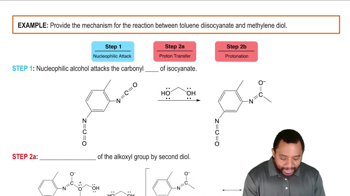
Polyurethane Mechanism Example 1
635
views
1
rank
1:43
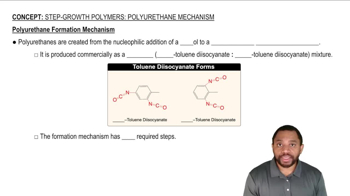
Polyurethane Mechanism Concept 1
636
views
이 집합의 용어 (14)
하이드의 정의
Polyurethane
A polymer formed by linking diols and toluene diisocyanate through urethane bonds in a two-step nucleophilic addition process.
Nucleophilic Addition
A reaction where an electron-rich species attacks an electron-deficient carbon, key in forming urethane linkages.
Diol
A molecule containing two hydroxyl groups, serving as a reactant in polyurethane synthesis.
Toluene Diisocyanate
An aromatic compound with two isocyanate groups, commonly used in an 80:20 mixture of 2,4 and 2,6 isomers.
2,4-Isomer
The major form of toluene diisocyanate, with isocyanate groups at positions 2 and 4 relative to the methyl group.
2,6-Isomer
A minor form of toluene diisocyanate, with isocyanate groups at positions 2 and 6 on the aromatic ring.
Isocyanate Group
A functional group with the structure –N=C=O, highly reactive toward nucleophiles like alcohols.
Urethane Linkage
A bond formed between an alcohol and an isocyanate group, connecting monomer units in polyurethanes.
Addition Polymer
A macromolecule created by sequential addition of monomers without loss of small molecules.
Methyl Group
A –CH3 substituent on toluene, designated as position 1 for isomer identification in diisocyanates.
Mechanism
A stepwise description of how reactants convert to products, here involving two stages for polyurethane formation.
Isomer Distribution
The relative proportions of different structural forms, such as the 80:20 ratio of 2,4 to 2,6 toluene diisocyanate.
Functional Group
A specific group of atoms within molecules responsible for characteristic reactions, such as isocyanate in this context.
Materials Science
A field focused on the properties and applications of substances like polyurethanes in various industries.