Organic Chemistry
나의 코스
배우기
시험 준비
AI 튜터
학습 가이드
교과서적 해결책
플래시카드
탐험해 보세요
앱을 사용해 보세요
나의 코스
배우기
시험 준비
AI 튜터
학습 가이드
교과서적 해결책
플래시카드
탐험해 보세요
앱을 사용해 보세요
뒤로
Suzuki Reaction quiz
카드를 뒤집기 위해 탭할 수 있습니다.
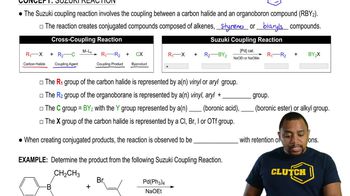
What two types of compounds are coupled in the Suzuki reaction?
카드를 뒤집기 위해 탭할 수 있습니다.
👆
What two types of compounds are coupled in the Suzuki reaction?
A carbon halide and an organoboron compound are coupled in the Suzuki reaction.
진행 상황 추적
컨트롤 버튼이 '내비게이션' 모드로 변경되었습니다.
1/15
관련 플래시카드
관련 실천
추천 영상
Suzuki Reaction definitions
Suzuki Reaction
15 용어
Suzuki Reaction
35. Transition Metals
7 문제점
주제

Ernest
Sonogashira Coupling Reaction
35. Transition Metals
3 문제점
주제
Ernest
27. Transition Metals
6 주제
14 문제점
장
Johnny
VideoThumbView.guidedCourse
03:58
Suzuki Reaction Example 1
1392
views
3
rank
VideoThumbView.guidedCourse
04:02
Suzuki Reaction
1516
views
9
rank
VideoThumbView.guidedCourse
03:22
Suzuki Reaction
1292
views
3
rank
이 집합의 용어 (15)
하이드의 정의
What two types of compounds are coupled in the Suzuki reaction?
A carbon halide and an organoboron compound are coupled in the Suzuki reaction.
What is the typical catalyst used in the Suzuki reaction?
A transition metal complex, usually palladium, is used as the catalyst.
Name three types of products that can be formed by the Suzuki reaction.
The Suzuki reaction can form alkenes, styrenes, or biaryls.
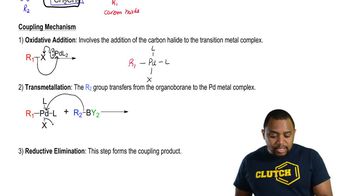
What are the three main steps in the catalytic cycle of the Suzuki reaction?
The three main steps are oxidative addition, transmetalation, and reductive elimination.
What happens during the oxidative addition step of the Suzuki reaction?
The carbon halide adds to the palladium complex, bonding palladium to both the halide and the organic group.
What occurs during the transmetalation step in the Suzuki reaction?
The R2 group from the organoboron compound transfers to the palladium, while the halide moves to the boron.
What is the purpose of the reductive elimination step in the Suzuki reaction?
Reductive elimination connects R1 and R2 to form the final product and regenerates the palladium catalyst.
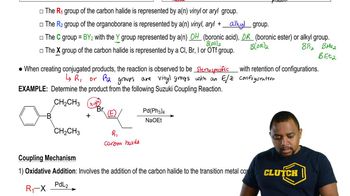
What are common leaving groups (X) in the carbon halide for the Suzuki reaction?
Common leaving groups are chlorine, bromine, iodine, or triflate.
What forms of organoboron compounds can be used in the Suzuki reaction?
Boronic acids (BOH2), boronic esters (B(OR)2), or boron compounds with alkyl groups (BR2) can be used.
What is the role of ligands (L) in the Suzuki reaction catalyst?
Ligands stabilize the transition metal catalyst, and there are usually 2 or 4 ligands.
What byproducts are formed in the Suzuki reaction?
The byproducts are the leaving group X and the BY2 group from the organoboron compound.
Why is the regeneration of the palladium catalyst important in the Suzuki reaction?
Regeneration allows the catalytic cycle to continue, making the reaction efficient and repeatable.
What is the main driving force for the Suzuki coupling reaction?
The main driving force is the formation of a more conjugated product and maintaining the electron count around palladium.
How does the Suzuki reaction help follow the 18 or 16 electron rule?
The reaction cycle adjusts the electron count around palladium, which seeks to maintain the 18 or 16 electron configuration.
What happens to the R1 and R2 groups in the Suzuki reaction?
R1 from the carbon halide and R2 from the organoboron compound combine to form the coupling product.