Skip to main content
Organic Chemistry
나의 코스
배우기
시험 준비
AI 튜터
학습 가이드
교과서적 해결책
플래시카드
탐험해 보세요
앱을 사용해 보세요
나의 코스
배우기
시험 준비
AI 튜터
학습 가이드
교과서적 해결책
플래시카드
탐험해 보세요
앱을 사용해 보세요
뒤로
Tertiary Protein Structure definitions
카드를 뒤집기 위해 탭할 수 있습니다.
Tertiary Structure
카드를 뒤집기 위해 탭할 수 있습니다.
👆
Tertiary Structure
Three-dimensional folding of a polypeptide chain, stabilized by interactions among side chains, leading to a functional protein conformation.
진행 상황 추적
컨트롤 버튼이 '내비게이션' 모드로 변경되었습니다.
1/13
관련 플래시카드
관련 실천
추천 영상
Tertiary Protein Structure quiz
Tertiary Protein Structure
15 용어
Tertiary Protein Structure
30. Peptides and Proteins
5 문제점
주제
Disulfide Bonds
30. Peptides and Proteins
5 문제점
주제
30. Peptides and Proteins - Part 1 of 3
4 주제
12 문제점
장
30. Peptides and Proteins - Part 2 of 3
4 주제
12 문제점
장
30. Peptides and Proteins - Part 3 of 3
4 주제
12 문제점
장
VideoThumbView.guidedCourse
2:41
Interactions within the Tertiary Structure Concept 2
760
views
VideoThumbView.guidedCourse
1:17
Tertiary Protein Structure Example 1
730
views
VideoThumbView.guidedCourse
0:57
Tertiary Protein Structure Example 2
758
views
이 집합의 용어 (13)
하이드의 정의
Tertiary Structure
Three-dimensional folding of a polypeptide chain, stabilized by interactions among side chains, leading to a functional protein conformation.
Polypeptide Chain
A linear sequence of amino acids linked by peptide bonds, serving as the backbone for protein folding.
Alpha Helix
A spiral-shaped secondary structure segment within proteins, often present in folded tertiary arrangements.
Beta Pleated Sheet
A sheet-like secondary structure formed by hydrogen bonds between backbone atoms, contributing to protein folding.
R Group
A variable side chain of an amino acid, whose properties drive interactions that stabilize protein folding.
Hydrophobic Interaction
A non-covalent force where nonpolar side chains cluster away from water, promoting protein stability.
Hydrophilic Interaction
A non-covalent force where polar side chains interact favorably with water, aiding protein solubility.
Hydrogen Bonding
An attraction between a hydrogen atom and an electronegative atom, stabilizing folded protein regions.
Salt Bridge
An ionic bond between oppositely charged side chains, contributing to the stabilization of protein structure.
Disulfide Bridge
A covalent bond formed between two cysteine residues, locking protein regions together for added stability.
Cysteine Residue
An amino acid unit with a thiol group, capable of forming strong covalent links in protein folding.
Peptide Bond
A covalent linkage between amino acids, forming the backbone of polypeptide chains.
Non-covalent Interaction
A stabilizing force in protein folding, including hydrophobic, hydrophilic, hydrogen bonding, and ionic attractions.
 뒤로뒤로
뒤로뒤로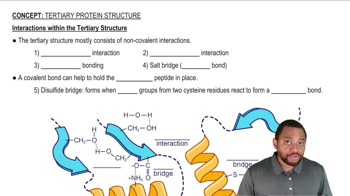
 2:41
2:41