Skip to main content
Organic Chemistry
나의 코스
배우기
시험 준비
AI 튜터
학습 가이드
교과서적 해결책
플래시카드
탐험해 보세요
앱을 사용해 보세요
나의 코스
배우기
시험 준비
AI 튜터
학습 가이드
교과서적 해결책
플래시카드
탐험해 보세요
앱을 사용해 보세요
뒤로
Ziegler-Natta Polymerization quiz
카드를 뒤집기 위해 탭할 수 있습니다.
What type of catalyst is used in Ziegler-Natta polymerization?
카드를 뒤집기 위해 탭할 수 있습니다.
👆
What type of catalyst is used in Ziegler-Natta polymerization?
An organometallic catalyst, typically containing titanium and aluminum compounds, is used.
진행 상황 추적
컨트롤 버튼이 '내비게이션' 모드로 변경되었습니다.
1/15
관련 플래시카드
관련 실천
추천 영상
Ziegler-Natta Polymerization definitions
Ziegler-Natta Polymerization
15 용어
Ziegler-Natta Polymerization
36. Synthetic Polymers
5 문제점
주제
Copolymers
36. Synthetic Polymers
5 문제점
주제
36. Synthetic Polymers - Part 1 of 4
4 주제
12 문제점
장
36. Synthetic Polymers - Part 2 of 4
4 주제
12 문제점
장
36. Synthetic Polymers - Part 3 of 4
4 주제
12 문제점
장
36. Synthetic Polymers - Part 4 of 4
1 주제
3 문제점
장
VideoThumbView.guidedCourse
1:55
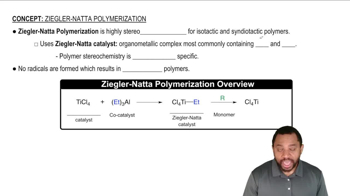
Ziegler-Natta Polymerization Concept 2
645
views
VideoThumbView.guidedCourse
1:03
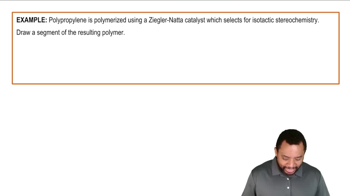
Ziegler-Natta Polymerization Example 1
636
views
VideoThumbView.guidedCourse
1:35
Ziegler-Natta Polymerization Concept 1
682
views
이 집합의 용어 (15)
하이드의 정의
What type of catalyst is used in Ziegler-Natta polymerization?
An organometallic catalyst, typically containing titanium and aluminum compounds, is used.
What is the main advantage of Ziegler-Natta polymerization regarding polymer structure?
It produces highly stereoselective polymers, such as isotactic or syndiotactic polymers, with linear structures.
Which two elements are most commonly found in Ziegler-Natta catalysts?
Titanium and aluminum are most commonly found in these catalysts.
What is the role of titanium tetrachloride in the Ziegler-Natta mechanism?
Titanium tetrachloride acts as the inactive catalyst that is activated by triethylaluminum.
How is the Ziegler-Natta catalyst activated?
It is activated when one ethyl group from triethylaluminum attaches to titanium tetrachloride.
What is the first step in the Ziegler-Natta polymerization mechanism?
The first step is the activation of the catalyst.
What happens during the coordination step of the Ziegler-Natta mechanism?
The π bond electrons of the alkene monomer coordinate with the titanium center.
How does chain growth occur in Ziegler-Natta polymerization?
The monomer inserts between the titanium and ethyl group, and this process repeats to grow the polymer chain.
Why are no free radicals formed in Ziegler-Natta polymerization?
The mechanism involves coordination and insertion steps, not radical intermediates.
What type of polymers does Ziegler-Natta polymerization typically produce?
It typically produces linear polymers with defined stereochemistry.
Why can't monomers with polar groups be used in Ziegler-Natta polymerization?
Polar groups deactivate the catalyst, preventing polymerization.
What determines the stereochemistry of the polymer in Ziegler-Natta polymerization?
The specific catalyst used determines the polymer's stereochemistry.
What is the role of triethylaluminum in the Ziegler-Natta catalyst system?
Triethylaluminum acts as a cocatalyst, donating an ethyl group to activate titanium.
What is the repeating process in Ziegler-Natta polymerization that leads to polymer growth?
The coordination and insertion steps are repeated to add more monomer units.
What is the significance of catalyst specificity in Ziegler-Natta polymerization?
Catalyst specificity allows for control over the polymer's stereoregularity and properties.
 뒤로뒤로
뒤로뒤로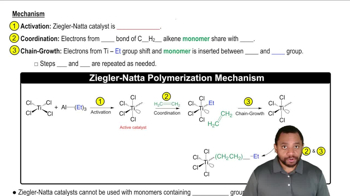
 1:55
1:55