Skip to main content
Organic Chemistry
나의 코스
배우기
시험 준비
AI 튜터
학습 가이드
교과서적 해결책
플래시카드
탐험해 보세요
앱을 사용해 보세요
나의 코스
배우기
시험 준비
AI 튜터
학습 가이드
교과서적 해결책
플래시카드
탐험해 보세요
앱을 사용해 보세요
뒤로
Carboxylic Acids and Derivatives - Organic Chemistry
카드를 뒤집기 위해 탭할 수 있습니다.
How are carboxylic acids prepared from Grignard reagents?
카드를 뒤집기 위해 탭할 수 있습니다.
👆
How are carboxylic acids prepared from Grignard reagents?
Treat a Grignard reagent with carbon dioxide to form a magnesium carboxylate salt, then protonate with aqueous acid to obtain the carboxylic acid.
진행 상황 추적
컨트롤 버튼이 '내비게이션' 모드로 변경되었습니다.
1/20
추천 영상
04:06
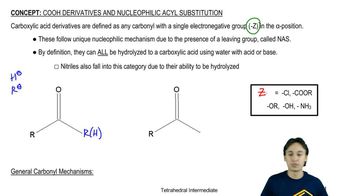
Intro to Nucleophilic Acyl Substituion
2531
views
58
rank
2
comments
03:50
Intro to Carboxylic Acid Derivatives
3021
views
38
rank
2
comments
이 집합의 용어 (20)
하이드의 정의
How are carboxylic acids prepared from Grignard reagents?
Treat a Grignard reagent with carbon dioxide to form a magnesium carboxylate salt, then protonate with aqueous acid to obtain the carboxylic acid.
What reagent reduces carboxylic acids to primary alcohols?
Lithium aluminum hydride (LiAlH4) reduces carboxylic acids to 1° alcohols in ether or THF.
How can aldehydes or ketones be selectively reduced in the presence of carboxylic acids?
Use sodium borohydride (NaBH4), which reduces aldehydes and ketones but not carboxylic acids.
What is Fischer esterification?
Preparation of esters by treating a carboxylic acid with an alcohol in the presence of an acid catalyst like H2SO4.
How are acid chlorides typically prepared?
By treating carboxylic acids with thionyl chloride (SOCl2).
What determines the relative reactivity of carboxylic acid derivatives toward nucleophilic acyl substitution?
Leaving group ability and resonance stabilization; weaker bases are better leaving groups, increasing reactivity.
Order the reactivity of carboxylic acid derivatives from most to least reactive.
Acid halides > acid anhydrides > esters > amides.
What are the three main types of reactions for carboxylic acid derivatives?
Hydrolysis (to carboxylic acid), alcoholysis (to ester), and aminolysis (to amide).
How do acid chlorides react with water?
They hydrolyze rapidly to form carboxylic acids and HCl without needing acid or base catalysis.
Describe the hydrolysis of esters under acidic conditions.
Acid-catalyzed ester hydrolysis is reversible and involves protonation of the carbonyl, nucleophilic attack by water, and loss of the alcohol group.
What is the difference between acid and base hydrolysis of esters?
Acid hydrolysis is reversible and catalytic; base hydrolysis is irreversible and requires stoichiometric base.
How are amides hydrolyzed in aqueous base?
Hydroxide ion attacks the carbonyl carbon, forming a tetrahedral intermediate that expels the amide anion, which is then protonated.
What products form when acid halides react with alcohols?
Esters are formed; no catalyst is needed due to high reactivity of acid halides.
What is transesterification?
The acid-catalyzed reaction of an ester with an alcohol, which is an equilibrium process that can be driven by changing conditions.
Do amides react with alcohols under normal conditions?
No, amides are the least reactive carboxylic acid derivatives and do not react with alcohols.
How do acid halides react with ammonia or amines?
They form amides; two moles of ammonia or amine are needed—one to form the amide and one to neutralize the HCl formed.
Describe the reaction of esters with Grignard reagents.
One mole of Grignard reagent forms a ketone intermediate, which reacts with a second mole to give a tertiary alcohol after hydrolysis.
What reagent reduces esters to two alcohols?
Lithium aluminum hydride (LiAlH4) reduces esters to a primary alcohol and an alcohol derived from the alkoxy group.
What is the role of diisobutylaluminum hydride (DIBALH) in ester reduction?
DIBALH reduces esters to aldehydes at low temperature (−78°C), allowing selective partial reduction.
What products result from LiAlH4 reduction of amides?
Primary, secondary, or tertiary amines depending on the amide substitution.
 뒤로뒤로
뒤로뒤로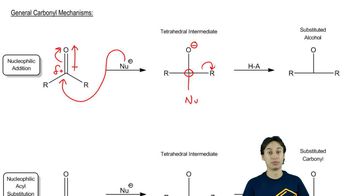
 04:06
04:06