 뒤로
뒤로Organic Chemistry: Functional Groups
 01:30
01:30
이 집합의 용어 (20)
A functional group is a specific group of atoms within a molecule responsible for its characteristic chemical reactions.
They determine the reactivity and properties of organic compounds.
The hydroxyl group (-OH) is characteristic of alcohols.
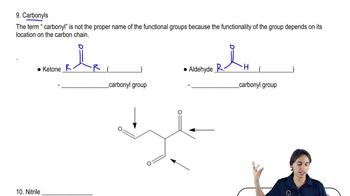
The aldehyde group contains a carbonyl bonded to at least one hydrogen: -CHO.
The ketone group has a carbonyl bonded to two carbon atoms: RC(=O)R'.
The carboxyl group (-COOH) defines carboxylic acids.
Amines contain an amino group (-NH2, -NHR, or -NR2).
An ester has the structure RCOOR', with a carbonyl adjacent to an oxygen bonded to another carbon.
Ethers contain an oxygen atom connected to two alkyl or aryl groups: R-O-R'.
Amides have a carbonyl group bonded to a nitrogen atom: RCONH2, RCONHR, or RCONR2.
Nitriles contain a cyano group (-C≡N).
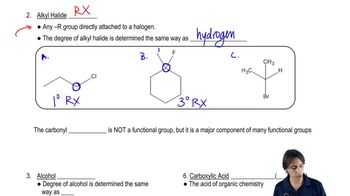
They contain a halogen atom (F, Cl, Br, I) bonded to carbon.
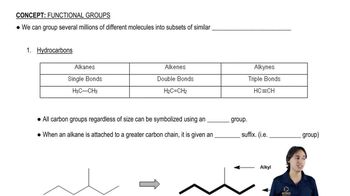
Alkenes have a carbon-carbon double bond (C=C).
Alkynes contain a carbon-carbon triple bond (C≡C).
Phenols have a hydroxyl group (-OH) directly bonded to an aromatic ring.
Aldehydes have a carbonyl bonded to at least one hydrogen, ketones have the carbonyl bonded to two carbons.
Amide groups link monomers in polyamides like nylon.
The carboxyl group (-COOH) in acetic acid gives vinegar its acidity.
Polar functional groups increase solubility in water, while nonpolar groups decrease it.
The amino group (-NH2) can accept protons, making amines basic.