 뒤로
뒤로Organic Chemistry II Functional Groups
 01:30
01:30
이 집합의 용어 (35)
General structure: RCH=CHR
IUPAC naming: suffix -ene, prefix alkenyl-
Example: Ethene (C2H4)
Reactivity: Electrophilic addition at the double bond
Spectroscopy: IR stretch ~1650 cm-1, 1H NMR vinyl protons 4.5-6.5 ppm
General structure: RC≡CR
IUPAC naming: suffix -yne, prefix alkynyl-
Example: Ethyne (acetylene, C2H2)
Reactivity: Nucleophilic addition, acidic terminal H
Spectroscopy: IR stretch ~2100-2260 cm-1, 1H NMR terminal alkyne H ~2.5 ppm
General structure: C6H5 (aromatic ring)
IUPAC naming: suffix -benzene, prefix phenyl-
Example: Benzene (C6H6)
Reactivity: Electrophilic aromatic substitution
Spectroscopy: IR C=C stretch ~1500-1600 cm-1, 1H NMR aromatic protons 6.5-8 ppm
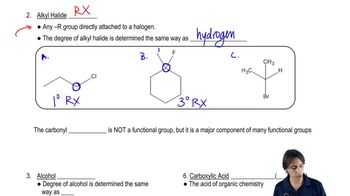
General structure: R–X (X = F, Cl, Br, I)
IUPAC naming: prefix halo-
Example: Chloromethane (CH3Cl)
Reactivity: Electrophilic carbon, good leaving group
Spectroscopy: C–X stretch IR varies (600-800 cm-1), 1H NMR shifts depend on halogen
General structure: R–OH
IUPAC naming: suffix -ol, prefix hydroxy-
Example: Ethanol (C2H5OH)
Reactivity: Weakly acidic, nucleophilic oxygen
Spectroscopy: Broad IR O–H stretch ~3200-3600 cm-1, 1H NMR OH proton 1-5 ppm (variable)
General structure: Ar–OH (aromatic OH)
IUPAC naming: suffix -ol, prefix hydroxy-
Example: Phenol (C6H5OH)
Reactivity: More acidic than alcohols, nucleophilic aromatic substitution
Spectroscopy: Broad IR O–H stretch ~3200-3600 cm-1, 1H NMR OH proton ~4-7 ppm
General structure: R–O–R'
IUPAC naming: prefix alkoxy-
Example: Dimethyl ether (CH3OCH3)
Reactivity: Generally inert, weakly nucleophilic oxygen
Spectroscopy: IR C–O stretch ~1050-1150 cm-1, 1H NMR alkyl protons 3.3-4 ppm (near oxygen)
General structure: Three-membered cyclic ether (triangle with O)
IUPAC naming: suffix -irane
Example: Ethylene oxide (C2H4O)
Reactivity: Highly strained, electrophilic ring-opening
Spectroscopy: IR C–O–C stretch ~1250 cm-1, 1H NMR ring protons 2.5-3.5 ppm
General structure: R–SH
IUPAC naming: suffix -thiol, prefix mercapto-
Example: Ethanethiol (C2H5SH)
Reactivity: Weak acid, nucleophilic sulfur
Spectroscopy: IR S–H stretch ~2550-2700 cm-1, 1H NMR SH proton ~1-3 ppm
General structure: R–S–R'
IUPAC naming: prefix alkylthio-
Example: Dimethyl sulfide (CH3SCH3)
Reactivity: Nucleophilic sulfur, less reactive than thiol
Spectroscopy: IR C–S stretch ~700 cm-1, 1H NMR alkyl protons 2-3 ppm (near S)
General structure: RNH2 (1°), R2NH (2°), R3N (3°)
IUPAC naming: suffix -amine, prefix amino-
Example: Methylamine (CH3NH2)
Reactivity: Basic, nucleophilic nitrogen
Spectroscopy: IR N–H stretch ~3300-3500 cm-1, 1H NMR NH protons 1-5 ppm (broad)
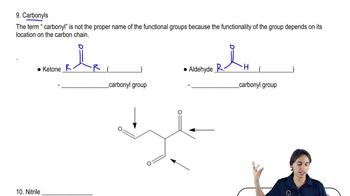
General structure: RCHO
IUPAC naming: suffix -al
Example: Formaldehyde (HCHO)
Reactivity: Electrophilic carbonyl carbon
Spectroscopy: IR C=O stretch ~1720 cm-1, 1H NMR aldehyde proton 9-10 ppm
General structure: RCOR'
IUPAC naming: suffix -one
Example: Acetone (CH3COCH3)
Reactivity: Electrophilic carbonyl carbon
Spectroscopy: IR C=O stretch ~1715 cm-1, 1H NMR alpha protons 2-2.5 ppm
General structure: RCOOH
IUPAC naming: suffix -oic acid
Example: Acetic acid (CH3COOH)
Reactivity: Acidic, electrophilic carbonyl
Spectroscopy: Broad IR O–H stretch ~2500-3300 cm-1, C=O stretch ~1710 cm-1, 1H NMR acidic proton 10-13 ppm
General structure: RCOCl
IUPAC naming: suffix -oyl chloride
Example: Acetyl chloride (CH3COCl)
Reactivity: Very reactive electrophile, nucleophilic acyl substitution
Spectroscopy: IR C=O stretch ~1800 cm-1, 1H NMR alpha protons 2-2.5 ppm
General structure: (RCO)2O
IUPAC naming: suffix -oic anhydride
Example: Acetic anhydride ((CH3CO)2O)
Reactivity: Reactive electrophile, nucleophilic acyl substitution
Spectroscopy: IR C=O stretches ~1800 and 1750 cm-1, 1H NMR alpha protons 2-2.5 ppm
General structure: RCOOR'
IUPAC naming: suffix -oate
Example: Ethyl acetate (CH3COOCH2CH3)
Reactivity: Less reactive electrophile, nucleophilic acyl substitution
Spectroscopy: IR C=O stretch ~1735 cm-1, 1H NMR alpha protons 2-2.5 ppm
General structure: RCONR'R''
IUPAC naming: suffix -amide
Example: Acetamide (CH3CONH2)
Reactivity: Least reactive electrophile, resonance stabilized
Spectroscopy: IR C=O stretch ~1650 cm-1, N–H stretch ~3200-3500 cm-1, 1H NMR NH protons 6-8 ppm
General structure: R–C≡N
IUPAC naming: suffix -nitrile
Example: Acetonitrile (CH3CN)
Reactivity: Electrophilic carbon, polar triple bond
Spectroscopy: IR C≡N stretch ~2200-2250 cm-1, 1H NMR alpha protons 2-3 ppm
General structure: R2C=NR'
IUPAC naming: suffix -imine
Example: Benzylideneaniline (C6H5CH=NC6H5)
Reactivity: Electrophilic C=N, nucleophilic N
Spectroscopy: IR C=N stretch ~1640-1690 cm-1, 1H NMR imine proton 7-9 ppm
General structure: Alkene adjacent to amine: R2C=CR–NR2
IUPAC naming: no special suffix, named as substituted amines
Example: N,N-Dimethyl enamine
Reactivity: Nucleophilic alkene, reacts with electrophiles
Spectroscopy: IR C=C stretch ~1600-1650 cm-1, 1H NMR alkene protons 4.5-6 ppm
General structure: Enol: R–C=C–OH; Enolate: R–C=C–O-
IUPAC naming: no special suffix, tautomers of carbonyls
Example: Acetaldehyde enol form
Reactivity: Nucleophilic at alpha carbon
Spectroscopy: IR O–H stretch ~3200-3600 cm-1, 1H NMR vinyl protons 4.5-6 ppm
General structure: R–CH(OH)–OR'
IUPAC naming: intermediate, no suffix
Example: Glucose cyclic hemiacetal
Reactivity: Intermediate in acetal formation
Spectroscopy: IR O–H stretch broad, 1H NMR anomeric proton 4.5-5.5 ppm
General structure: R–CH(OR')2
IUPAC naming: no suffix, protected aldehyde/ketone
Example: Dimethyl acetal of acetaldehyde
Reactivity: Stable protecting group, inert to bases
Spectroscopy: IR no carbonyl stretch, 1H NMR acetal protons 4.5-5.5 ppm
General structure: R–CH=CH–C=O–R'
IUPAC naming: suffix -enone
Example: Mesityl oxide
Reactivity: Conjugate (Michael) addition electrophile
Spectroscopy: IR C=O stretch ~1680-1700 cm-1, 1H NMR vinyl protons 5.5-7 ppm
General structure: R–NO2
IUPAC naming: prefix nitro-
Example: Nitrobenzene (C6H5NO2)
Reactivity: Electron withdrawing, deactivates aromatic ring
Spectroscopy: IR asymmetric stretch ~1520-1550 cm-1, symmetric ~1340-1380 cm-1
General structure: Six-membered ring with one N
IUPAC naming: pyridine
Example: Pyridine (C5H5N)
Reactivity: Basic nitrogen, electrophilic substitution on ring
Spectroscopy: IR ring modes ~1600 cm-1, 1H NMR aromatic 7-9 ppm
General structure: Five-membered ring with one N
IUPAC naming: pyrrole
Example: Pyrrole (C4H5N)
Reactivity: Electron rich, electrophilic substitution
Spectroscopy: IR N–H stretch ~3400 cm-1, 1H NMR aromatic 6-7 ppm
General structure: Five-membered ring with one O
IUPAC naming: furan
Example: Furan (C4H4O)
Reactivity: Electron rich, electrophilic substitution
Spectroscopy: IR C–O stretch ~1050-1150 cm-1, 1H NMR aromatic 6-7 ppm
General structure: Five-membered ring with one S
IUPAC naming: thiophene
Example: Thiophene (C4H4S)
Reactivity: Electron rich, electrophilic substitution
Spectroscopy: IR C–S stretch ~700 cm-1, 1H NMR aromatic 6.5-7.5 ppm
Most reactive to least reactive: Acid chloride > Acid anhydride > Ester > Amide
Reason: Leaving group ability and resonance stabilization
Acidity (pKa approx): Carboxylic acid (~4-5) > Phenol (~10) > Alcohol (~16) > Terminal alkyne (~25) > Amine (~35)
Which functional group does this indicate?
IR peak ~1720 cm-1
Aldehyde or ketone carbonyl (C=O stretch)
Which functional group does this indicate?
1H NMR shift ~9-10 ppm
Aldehyde proton
Which functional group does this indicate?
IR broad stretch ~3200-3600 cm-1
Alcohol or phenol O–H stretch