 뒤로
뒤로Amines and Their Derivatives: Structure, Reactivity, and Synthesis
스터디 가이드 - 스마트 노트
 자료에 맞춘 맞춤형 노트, 핵심 정의, 예시, 맥락을 확장해 제공합니다.
Amines and Their Derivatives
Introduction to Amines
Amines are organic derivatives of ammonia (NH3) in which one or more hydrogen atoms are replaced by alkyl or aryl groups. They are fundamental in biological systems, serving as neurotransmitters, vitamins, and drugs. Their structure and reactivity are central to many organic transformations and synthetic strategies.
Definition: Amines are compounds containing a nitrogen atom bonded to one or more alkyl or aryl groups.
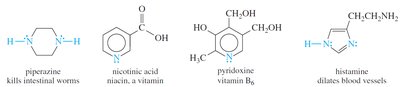
Biological Importance: Many amines function as bioregulators, neurotransmitters, and pharmaceuticals.
Examples: Piperazine (anthelmintic), niacin (vitamin), pyridoxine (vitamin B6), and histamine (vasodilator).
Nomenclature of Amines
Classification of Amines
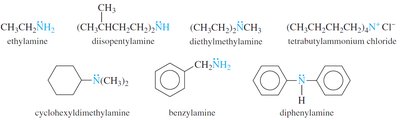
Amines are classified based on the number of organic substituents attached to the nitrogen atom:
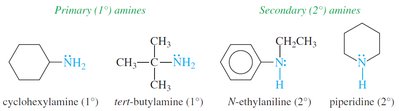
Primary (1°) amines: One alkyl or aryl group attached to nitrogen.
Secondary (2°) amines: Two alkyl or aryl groups attached to nitrogen.
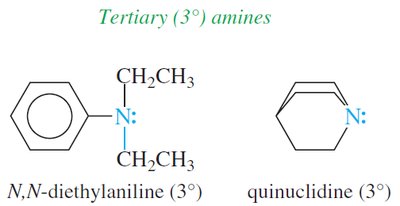
Tertiary (3°) amines: Three alkyl or aryl groups attached to nitrogen.
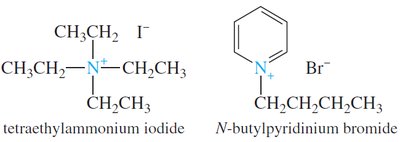
Quaternary ammonium salts: Four organic groups attached to nitrogen, which carries a positive charge.
Common and IUPAC Nomenclature
The naming of amines follows specific conventions:
Common Names: List the alkyl groups attached to nitrogen in alphabetical order, followed by "amine." Use prefixes di-, tri-, tetra- for identical groups.
IUPAC Names: The parent chain is the longest carbon chain bonded to nitrogen. The suffix "-amine" replaces the "-e" of the alkane. The position of the amino group is indicated by a number, and substituents on nitrogen are denoted by "N-".
Amino Group as Substituent: In complex molecules, the –NH2 group is called "amino" and its position is specified.

Practice: Naming and Drawing Amines
Draw the structures: tert-butylamine, α-aminopropionaldehyde, N-ethyl-N-methylhexan-3-amine, m-chloroaniline.
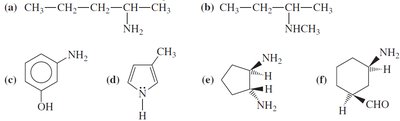
Name the following: (Structures provided for practice.)
Basicity of Amines
Basic Properties
Amines act as bases due to the lone pair of electrons on nitrogen, which can accept protons (Brønsted–Lowry base) or form bonds with electrophiles (Lewis base).
Nucleophilicity: Amines are nucleophilic and participate in substitution and addition reactions.
Protonation: Amines can accept a proton to form ammonium ions.
Aromatic Substitution of Amines
Electrophilic Aromatic Substitution
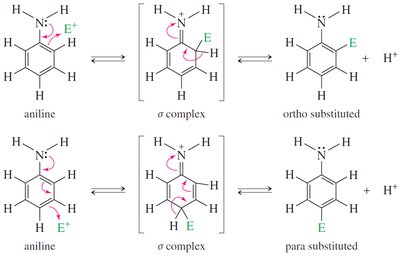
Amino groups are strong activating groups and direct electrophilic substitution to the ortho and para positions on aromatic rings. The lone pair on nitrogen stabilizes the intermediate carbocation (σ-complex).
Ortho/Para Directing: Substitution occurs preferentially at these positions.
Activation: Amino groups increase the reactivity of the aromatic ring toward electrophiles.
Halogenation of Aniline Derivatives
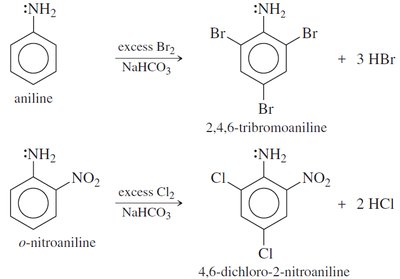
Halogenation of aniline and its derivatives occurs readily, often without a catalyst. Excess halogen leads to multiple substitutions at ortho and para positions.
Alkylation of Amines
Alkylation by Alkyl Halides
Amines react with primary alkyl halides via the SN2 mechanism to form alkylated ammonium salts. Tertiary halides are too hindered for this reaction, and secondary halides often give poor yields due to elimination side reactions.

Acylation of Amines
Reaction with Acid Halides
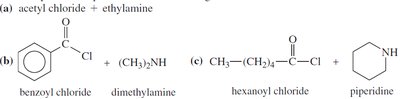
Primary and secondary amines react with acid chlorides to form amides in a nucleophilic acyl substitution reaction. Pyridine is often used as a base to neutralize the HCl formed.

Example: Benzoyl chloride + dimethylamine; hexanoyl chloride + piperidine.
Hofmann Elimination: Amines as Leaving Groups
Mechanism and Orientation
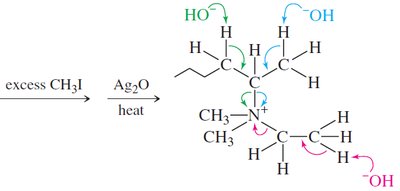
Amines can be converted to alkenes via the Hofmann elimination, which involves exhaustive methylation to form a quaternary ammonium salt, followed by elimination (E2) with silver oxide and heat. Unlike typical eliminations, the Hofmann elimination gives the least substituted alkene (anti-Zaitsev product).

Orientation: The major product is the least substituted alkene due to steric effects.
Practice: Predicting Products
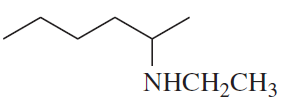
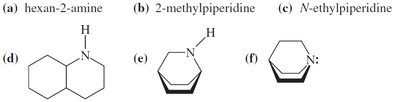
Predict the major products formed when amines undergo exhaustive methylation, treatment with Ag2O, and heating.
Oxidation of Amines and the Cope Elimination
Oxidation Reactions
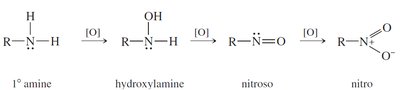
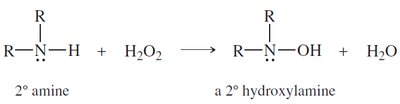
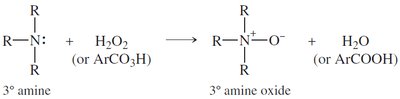
Amines can be oxidized by agents such as H2O2, permanganate, or peroxyacids. The products depend on the degree of substitution:
Primary amines: Oxidize to complex mixtures, including nitroso and nitro compounds.
Secondary amines: Oxidize to hydroxylamines.
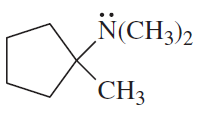
Tertiary amines: Oxidize to amine oxides, which can undergo Cope elimination to give alkenes (least substituted product).
Practice: Predicting Oxidation Products
Predict the products when amines are treated with H2O2 and heated.
Reactions of Amines with Nitrous Acid
Diazotization and Decomposition
Primary amines react with nitrous acid (HNO2) to form diazonium salts via the nitrosonium ion intermediate. Aliphatic diazonium salts are unstable and decompose to give nitrogen gas and carbocations.

Reactions of Arenediazonium Salts
Formation and Synthetic Utility
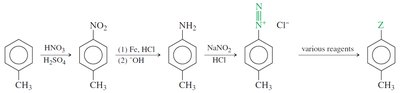
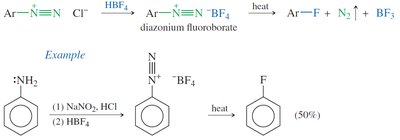
Arenediazonium salts are formed by diazotizing aromatic amines. These salts are versatile intermediates for introducing various functional groups onto aromatic rings via substitution reactions (Sandmeyer and related reactions).
Preparation: Nitration of aromatic ring, reduction to amine, diazotization.
Functional Group Interconversions: Hydroxide (hydrolysis), halides (Sandmeyer), cyanide, and others.
Deamination of Anilines
The diazonium group can be reduced to hydrogen, effectively removing the amino group from the aromatic ring (deamination).
Practice: Synthetic Applications
Convert toluene to 3,5-dibromotoluene (cannot be done by direct bromination due to regioselectivity).
Convert aniline to fluorobenzene, chlorobenzene, 1,3,5-trimethylbenzene, bromobenzene, iodobenzene, benzonitrile, and phenol via diazonium chemistry.
Synthesis of Amines
Reductive Amination
Reductive amination is a key method for synthesizing amines. It involves the formation of an imine (or oxime) from a ketone or aldehyde, followed by reduction to the corresponding amine.
Step 1: Formation of imine or oxime derivative.
Step 2: Reduction to primary, secondary, or tertiary amine, depending on the starting materials.



Additional info: Reductive amination is widely used in pharmaceutical synthesis due to its versatility and efficiency in forming C–N bonds.
