Ch. 10 - Reactions of Alcohols, Ethers, Epoxides, Amines, and Sulfur-Containing Compounds
Bruice - Organic Chemistry 8th Edition
Bruice8th EditionOrganic ChemistryISBN: 9780135213711당신이 사용하는 게 아니라요?교과서 변경
10장, 문제 82a

Describe how each of the following compounds could be synthesized from the given starting material.
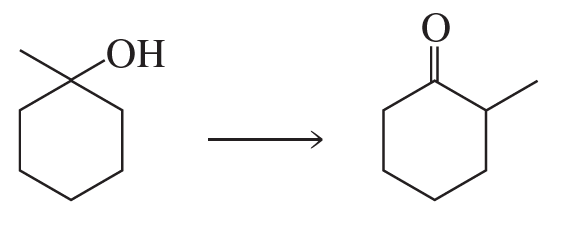
a. Synthesis reaction showing a compound with an alcohol group converting to a carbonyl compound.

검증된 단계별 안내
1
Step 1: Analyze the starting material and the product. The starting material is a cyclohexanol derivative, and the product is a cyclohexanone derivative. This indicates that the reaction involves the oxidation of the alcohol group (-OH) to a ketone group (C=O).
Step 2: Select an appropriate oxidizing agent for the transformation. Common oxidizing agents for converting secondary alcohols to ketones include PCC (Pyridinium Chlorochromate), Jones reagent (CrO3/H2SO4), or Dess-Martin periodinane.
Step 3: Set up the reaction conditions. For example, if using PCC, the reaction is typically carried out in an anhydrous solvent like dichloromethane (CH2Cl2) to prevent overoxidation.
Step 4: Perform the oxidation reaction. Add the oxidizing agent to the cyclohexanol derivative under controlled conditions, ensuring the reaction proceeds to form the ketone without side reactions.
Step 5: Purify the product. After the reaction is complete, isolate the cyclohexanone derivative by techniques such as distillation or recrystallization, depending on the physical properties of the product.

비슷한 문제에 대한 검증된 영상 답변:

이 영상 해법은 위 문제에 도움이 된다고 튜터들이 추천한 것입니다.
영상 길이:
5m

주요 개념

질문에 올바르게 답하기 위해 반드시 이해해야 하는 핵심 개념들은 다음과 같습니다.

Functional Groups

Functional groups are specific groups of atoms within molecules that are responsible for the characteristic chemical reactions of those molecules. In organic chemistry, understanding the functional groups present in a compound is crucial for predicting reactivity and synthesis pathways. For example, the presence of hydroxyl (-OH) groups indicates alcohols, which can undergo various reactions such as dehydration or oxidation.
추천 영상:
02:36
Identifying Functional Groups

Reaction Mechanisms

A reaction mechanism is a step-by-step description of how a chemical reaction occurs, detailing the bond-breaking and bond-forming processes. Understanding mechanisms is essential for predicting the products of a reaction and for designing synthetic pathways. For instance, knowing whether a reaction proceeds via an electrophilic addition or a nucleophilic substitution can guide the choice of reagents and conditions needed for synthesis.
추천 영상:
02:16
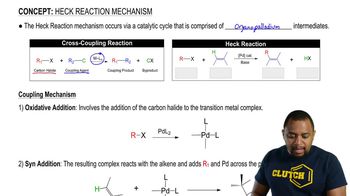
Heck Reaction Mechanism

Stereochemistry

Stereochemistry involves the study of the spatial arrangement of atoms in molecules and how this affects their chemical behavior. In organic synthesis, the stereochemical configuration of reactants can influence the outcome of reactions, leading to different isomers. Recognizing stereochemical aspects is vital when synthesizing compounds, as it can determine the selectivity and yield of the desired product.
추천 영상:
가이드 코스
1:38
Polymer Stereochemistry Concept 1