Ch. 10 - Reactions of Alcohols, Ethers, Epoxides, Amines, and Sulfur-Containing Compounds
Bruice - Organic Chemistry 8th Edition
Bruice8th EditionOrganic ChemistryISBN: 9780135213711당신이 사용하는 게 아니라요?교과서 변경
10장, 문제 58a

Starting with (R)-1-deuterio-1-propanol, how could you prepare
a. (S)-1-deuterio-1-propanol? 

검증된 단계별 안내
1
Identify the stereochemistry of the starting material, (R)-1-deuterio-1-propanol. The (R) configuration indicates the specific spatial arrangement of the substituents around the chiral center.
To convert the (R)-1-deuterio-1-propanol to its enantiomer, (S)-1-deuterio-1-propanol, you need to invert the stereochemistry at the chiral center. This can be achieved through a two-step process: conversion to an intermediate and subsequent inversion.
Step 1: Convert the alcohol group (-OH) into a good leaving group. This can be done by reacting (R)-1-deuterio-1-propanol with a reagent like p-toluenesulfonyl chloride (TsCl) in the presence of a base (e.g., pyridine) to form the corresponding tosylate. The tosylate group is an excellent leaving group.
Step 2: Perform an SN2 reaction with a nucleophile (e.g., hydroxide ion, OH⁻) to replace the tosylate group with a hydroxyl group. The SN2 mechanism involves a backside attack, which inverts the stereochemistry at the chiral center, resulting in (S)-1-deuterio-1-propanol.
Finally, confirm the stereochemistry of the product using spectroscopic methods (e.g., NMR or optical rotation) to ensure the desired (S)-configuration has been achieved.

비슷한 문제에 대한 검증된 영상 답변:

이 영상 해법은 위 문제에 도움이 된다고 튜터들이 추천한 것입니다.
영상 길이:
2m

주요 개념

질문에 올바르게 답하기 위해 반드시 이해해야 하는 핵심 개념들은 다음과 같습니다.

Stereochemistry

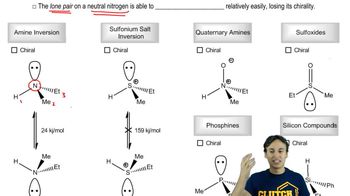
Stereochemistry is the study of the spatial arrangement of atoms in molecules and how this affects their chemical behavior. In this context, it is crucial to understand the difference between enantiomers, which are molecules that are mirror images of each other, such as (R)- and (S)-1-deuterio-1-propanol. The ability to manipulate these configurations is essential for synthesizing specific stereoisomers.
추천 영상:
가이드 코스
1:38
Polymer Stereochemistry Concept 1

Chiral Centers

A chiral center, often a carbon atom, is bonded to four different substituents, leading to non-superimposable mirror images. In the case of 1-deuterio-1-propanol, the chiral center's configuration determines whether the molecule is in the (R) or (S) form. Understanding how to identify and modify chiral centers is key to synthesizing the desired stereoisomer.
추천 영상:
05:41
Understanding Other Chiral Atoms

Reactions for Synthesis

Various chemical reactions can be employed to convert one stereoisomer into another, such as inversion reactions or specific chiral catalysts. For example, using a suitable reagent that selectively reacts with the (R)-1-deuterio-1-propanol can lead to the formation of (S)-1-deuterio-1-propanol. Familiarity with these synthetic pathways is essential for achieving the desired product.
추천 영상:
가이드 코스
1:16
Synthesis of Amino Acids: Strecker Synthesis Example 1