Ch. 10 - Reactions of Alcohols, Ethers, Epoxides, Amines, and Sulfur-Containing Compounds
Bruice - Organic Chemistry 8th Edition
Bruice8th EditionOrganic ChemistryISBN: 9780135213711당신이 사용하는 게 아니라요?교과서 변경
10장, 문제 89a

The following reaction takes place several times faster than the reaction of 2-chlorobutane with HO-:

a. Explain the enhanced reaction rate.

검증된 단계별 안내
1
Identify the structure of the compound in the reaction. 2-chlorobutane is a secondary alkyl halide, and the reaction involves a nucleophile (HO⁻). This suggests the reaction mechanism could be either SN1 or SN2.
Analyze the factors affecting the reaction rate. In an SN2 reaction, the rate depends on steric hindrance and the strength of the nucleophile. In an SN1 reaction, the rate depends on the stability of the carbocation intermediate formed after the leaving group departs.
Consider the leaving group. Chlorine (Cl) is a good leaving group because it can stabilize the negative charge after leaving as Cl⁻. This facilitates the reaction.
Examine the role of the nucleophile (HO⁻). Hydroxide is a strong nucleophile, which favors the SN2 mechanism. However, the reaction rate enhancement could also be due to the stability of the transition state or intermediate.
Propose the reason for the enhanced reaction rate. The enhanced rate could be due to a more favorable transition state or intermediate stability in the given reaction compared to 2-chlorobutane with HO⁻. For example, if the reaction involves a tertiary alkyl halide or a resonance-stabilized carbocation, the reaction rate would be significantly faster due to reduced steric hindrance (SN2) or increased carbocation stability (SN1).

비슷한 문제에 대한 검증된 영상 답변:

이 영상 해법은 위 문제에 도움이 된다고 튜터들이 추천한 것입니다.
영상 길이:
3m

주요 개념

질문에 올바르게 답하기 위해 반드시 이해해야 하는 핵심 개념들은 다음과 같습니다.

Nucleophilicity

Nucleophilicity refers to the ability of a nucleophile to donate an electron pair to an electrophile during a chemical reaction. In this context, HO- (hydroxide ion) is a strong nucleophile, but the structure of 2-chlorobutane may hinder its approach to the electrophilic carbon. A more accessible nucleophile or a better leaving group can significantly enhance the reaction rate.
추천 영상:
08:27
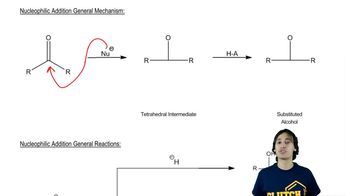
Nucleophilic Addition

Leaving Group Ability

The leaving group ability is a critical factor in determining the rate of nucleophilic substitution reactions. A good leaving group can stabilize the transition state and facilitate the departure from the substrate. In the case of 2-chlorobutane, if the leaving group is less favorable compared to other substrates, it can slow down the reaction, making it essential to consider the nature of the leaving group in the reaction mechanism.
추천 영상:
03:06
How to use the factors affecting acidity to predict leaving group ability.

Steric Hindrance

Steric hindrance refers to the crowding around a reactive site that can impede the approach of nucleophiles to electrophiles. In the case of 2-chlorobutane, the presence of bulky groups around the reactive carbon can slow down the reaction with HO-. A less hindered substrate would allow for a faster reaction rate, highlighting the importance of molecular structure in reaction kinetics.
추천 영상:
02:53
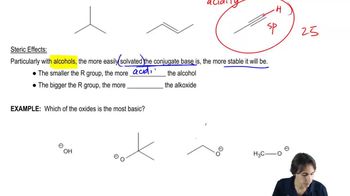
Understanding steric effects.