Ch. 10 - Reactions of Alcohols, Ethers, Epoxides, Amines, and Sulfur-Containing Compounds
Bruice - Organic Chemistry 8th Edition
Bruice8th EditionOrganic ChemistryISBN: 9780135213711당신이 사용하는 게 아니라요?교과서 변경
10장, 문제 11a

What stereoisomers do the following reactions form?
a. Chemical reaction diagram showing a substitution reaction with reagents PBri3/pyridine and CH3O-.

검증된 단계별 안내
1
Step 1: Analyze the starting material. The given compound is a cyclopentanol with a hydroxyl group (-OH) attached to a stereogenic center. The wedge and dash notation indicates the stereochemistry of the substituents.
Step 2: Examine the first reaction step. Phosphorus tribromide (PBr₃) in pyridine is used to convert the alcohol (-OH) group into a bromide (-Br) group. This reaction proceeds via an SN2 mechanism, which inverts the stereochemistry at the carbon center.
Step 3: Consider the second reaction step. Ethoxide ion (C₂H₅O⁻) acts as a nucleophile in an SN2 reaction with the bromide intermediate. This step also inverts the stereochemistry at the carbon center, resulting in a net retention of the original stereochemistry.
Step 4: Combine the stereochemical effects of both steps. Since both steps involve inversion of stereochemistry, the final product retains the original stereochemistry of the starting material.
Step 5: Conclude the stereoisomer formed. The final product is an ethoxy-substituted cyclopentane with the same stereochemistry as the starting material (wedge or dash orientation preserved).

비슷한 문제에 대한 검증된 영상 답변:

이 영상 해법은 위 문제에 도움이 된다고 튜터들이 추천한 것입니다.
영상 길이:
7m

주요 개념

질문에 올바르게 답하기 위해 반드시 이해해야 하는 핵심 개념들은 다음과 같습니다.

Stereoisomerism

Stereoisomerism refers to the phenomenon where compounds have the same molecular formula and connectivity of atoms but differ in the spatial arrangement of their atoms. This can lead to different physical and chemical properties. In organic chemistry, stereoisomers include enantiomers and diastereomers, which are crucial for understanding the behavior of chiral molecules in reactions.
추천 영상:
01:58
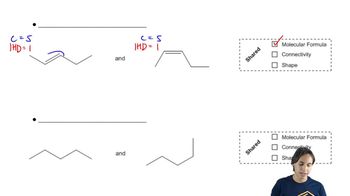
Determining when molecules are stereoisomers.

Reactions of Alcohols

Alcohols can undergo various reactions, including substitution and elimination. In this case, the reaction of an alcohol with phosphorus tribromide (PBr3) converts the alcohol into a bromide, which can then participate in further reactions. Understanding the mechanism of these reactions is essential for predicting the stereochemical outcomes.
추천 영상:
01:44
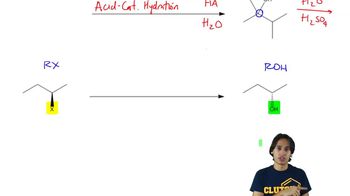
Forming alcohols through SN2 reactions.

Nucleophilic Substitution Mechanisms

Nucleophilic substitution mechanisms, such as SN1 and SN2, describe how nucleophiles replace leaving groups in organic molecules. The choice of mechanism affects the stereochemistry of the product. For example, SN2 reactions lead to inversion of configuration, while SN1 reactions can result in racemization, making it important to analyze the reaction conditions to determine the stereoisomers formed.
추천 영상:
01:47
Nucleophiles and Electrophiles can react in Substitution Reactions.