Ch. 12 - Radicals
Bruice - Organic Chemistry 8th Edition
Bruice8th EditionOrganic ChemistryISBN: 9780135213711당신이 사용하는 게 아니라요?교과서 변경
12장, 문제 45

At 600 °C, the ratio of the relative rates of formation of a tertiary, a secondary, and a primary radical by a chlorine radical is 2.6 : 2.1 : 1. Explain the change in the degree of regioselectivity compared to what was found in Problem 44.

검증된 단계별 안내
1
Understand the context: The problem involves the regioselectivity of radical formation during a chlorination reaction. Chlorine radicals are less selective than bromine radicals, and the regioselectivity depends on the relative stability of the radicals formed (tertiary > secondary > primary). The given ratio (2.6 : 2.1 : 1) reflects the relative rates of radical formation at 600 °C.
Recall the concept of regioselectivity: Regioselectivity refers to the preference for forming one constitutional isomer over another. In this case, the preference is based on the stability of the radicals formed. Tertiary radicals are the most stable due to hyperconjugation and inductive effects, followed by secondary and then primary radicals.
Compare with Problem 44: In Problem 44, the regioselectivity might have been different (likely higher) because the temperature or halogen used (e.g., bromine) could have influenced the selectivity. Higher temperatures, as in this problem (600 °C), reduce regioselectivity because the reaction becomes more kinetically controlled, and the energy difference between forming different radicals becomes less significant.
Explain the effect of temperature: At higher temperatures, the energy barrier for radical formation is more easily overcome, and the reaction becomes less selective. This is why the ratio of 2.6 : 2.1 : 1 shows a smaller difference between the rates of tertiary, secondary, and primary radical formation compared to what might have been observed at lower temperatures or with bromine radicals.
Summarize the change in regioselectivity: The degree of regioselectivity decreases at higher temperatures because the reaction becomes less dependent on the stability of the radicals and more dependent on the kinetic factors. This explains why the ratio of radical formation rates is closer together (2.6 : 2.1 : 1) compared to the likely higher regioselectivity in Problem 44.

비슷한 문제에 대한 검증된 영상 답변:

이 영상 해법은 위 문제에 도움이 된다고 튜터들이 추천한 것입니다.
영상 길이:
6m

주요 개념

질문에 올바르게 답하기 위해 반드시 이해해야 하는 핵심 개념들은 다음과 같습니다.

Radical Stability

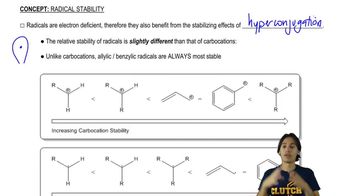
The stability of radicals is crucial in organic chemistry, as it influences their reactivity and formation rates. Tertiary radicals are more stable than secondary and primary radicals due to hyperconjugation and inductive effects from surrounding alkyl groups. This stability hierarchy explains why tertiary radicals are formed preferentially in reactions involving radical mechanisms.
추천 영상:
03:43
The radical stability trend.

Regioselectivity

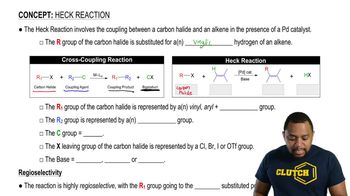
Regioselectivity refers to the preference of a chemical reaction to occur at one site over another in a molecule. In radical reactions, the regioselectivity can shift based on the stability of the resulting radicals. The observed ratio of radical formation indicates that the reaction conditions, such as temperature, can significantly influence which radicals are favored.
추천 영상:
05:09
Heck Reaction

Temperature Effects on Reaction Rates

Temperature plays a vital role in chemical reactions, affecting the kinetic energy of molecules and the rates of reaction. At higher temperatures, the increased energy can lead to a greater formation of radicals and can alter the selectivity of the reaction. In this case, the elevated temperature of 600 °C likely enhances the formation of more stable tertiary radicals, thus changing the regioselectivity compared to lower temperature conditions.
추천 영상:
가이드 코스
5:07
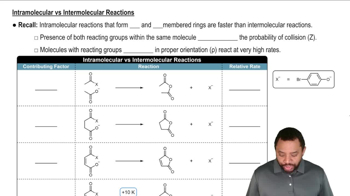
Rates of Intramolecular Reactions Concept 2