Ch. 12 - Radicals
Bruice - Organic Chemistry 8th Edition
Bruice8th EditionOrganic ChemistryISBN: 9780135213711당신이 사용하는 게 아니라요?교과서 변경
12장, 문제 26c

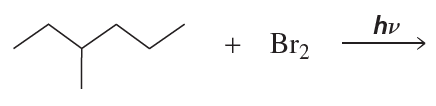
What are the product(s) of each of the following reactions? Disregard stereoisomers.
c. Chemical reaction showing an alkene reacting with bromine under light to form products.

검증된 단계별 안내
1
Step 1: Recognize the type of reaction. The presence of Br₂ and light (hν) indicates a free radical halogenation reaction, specifically bromination.
Step 2: Identify the substrate. The given molecule is 2-methylbutane, a branched alkane.
Step 3: Determine the most reactive hydrogen for bromination. Bromine prefers to react with the hydrogen attached to the most substituted carbon due to the stability of the resulting radical. In this case, the tertiary carbon (the central carbon in the molecule) is the most substituted.
Step 4: Predict the product. Bromine will replace the hydrogen on the tertiary carbon, forming 2-bromo-2-methylbutane as the major product.
Step 5: Note that minor products may form due to bromination at other positions, but the major product is determined by the stability of the intermediate radical.

비슷한 문제에 대한 검증된 영상 답변:

이 영상 해법은 위 문제에 도움이 된다고 튜터들이 추천한 것입니다.
영상 길이:
1m

주요 개념

질문에 올바르게 답하기 위해 반드시 이해해야 하는 핵심 개념들은 다음과 같습니다.

Free Radical Halogenation

Free radical halogenation is a reaction where alkenes react with halogens (like Br2) in the presence of light (hν) to form alkyl halides. The process involves the generation of free radicals, which are highly reactive species with unpaired electrons. The reaction typically proceeds through initiation, propagation, and termination steps, leading to the substitution of hydrogen atoms in the alkene with halogen atoms.
추천 영상:
12:11
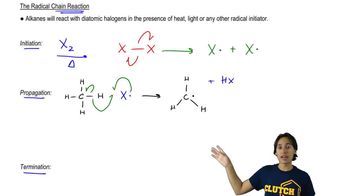
Radical Chain Reaction Mechanism.

Mechanism of Radical Reactions

The mechanism of radical reactions involves several key steps: initiation (where radicals are formed), propagation (where radicals react with stable molecules to form new radicals), and termination (where radicals combine to form stable products). In the case of bromination, the bromine molecule dissociates into two bromine radicals, which then react with the alkene to form bromoalkanes. Understanding this mechanism is crucial for predicting the products of the reaction.
추천 영상:
12:11
Radical Chain Reaction Mechanism.

Regioselectivity in Electrophilic Addition

Regioselectivity refers to the preference of a chemical reaction to yield one structural isomer over others when multiple products are possible. In the context of alkene bromination, the regioselectivity is influenced by the stability of the radical intermediates formed during the reaction. The more stable radical will lead to the major product, which is often determined by the degree of substitution of the carbon atom where the bromine adds.
추천 영상:
09:23
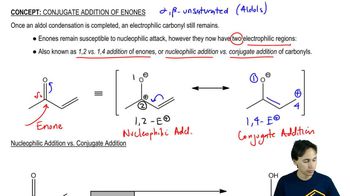
1,2 vs 1,4 Addition