Ch. 13 - Mass Spectrometry; Infrared Spectroscopy; UV/Vis Spectroscopy
Bruice - Organic Chemistry 8th Edition
Bruice8th EditionOrganic ChemistryISBN: 9780135213711당신이 사용하는 게 아니라요?교과서 변경
13장, 문제 13a

The mass spectra of 1-methoxybutane, 2-methoxybutane, and 2-methoxy-2-methylpropane are shown below. Match each compound with its spectrum.
<IMAGE>

검증된 단계별 안내
1
Analyze the molecular structure of each compound (1-methoxybutane, 2-methoxybutane, and 2-methoxy-2-methylpropane) to identify key features that could influence fragmentation patterns in mass spectrometry. For example, consider the position of the methoxy group (-OCH₃) and the branching of the carbon chain.
Understand the general principles of mass spectrometry: molecules are ionized, and the resulting ions fragment in predictable ways. Look for characteristic peaks in the spectra, such as the molecular ion peak (M⁺), base peak (most intense peak), and other significant fragment peaks.
For 1-methoxybutane, predict the fragmentation pattern. The methoxy group is attached to the first carbon, so cleavage near this group may produce a fragment with a mass corresponding to CH₃O⁺ (31 m/z) and another fragment corresponding to the remaining alkyl chain.
For 2-methoxybutane, the methoxy group is attached to the second carbon. This structure may lead to fragmentation that produces a peak for CH₃O⁺ (31 m/z) and other fragments resulting from cleavage at the adjacent carbons, such as a peak for a secondary carbocation.
For 2-methoxy-2-methylpropane, the highly branched structure and the methoxy group on a tertiary carbon will influence fragmentation. Expect a strong molecular ion peak (M⁺) and significant peaks for tertiary carbocations or other stable fragments. Match these predicted patterns to the spectra to identify each compound.

비슷한 문제에 대한 검증된 영상 답변:

이 영상 해법은 위 문제에 도움이 된다고 튜터들이 추천한 것입니다.

주요 개념

질문에 올바르게 답하기 위해 반드시 이해해야 하는 핵심 개념들은 다음과 같습니다.

Mass Spectrometry

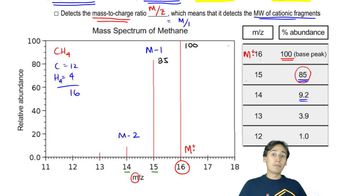
Mass spectrometry is an analytical technique used to measure the mass-to-charge ratio of ions. It involves ionizing chemical species and sorting the ions based on their mass. The resulting mass spectrum provides information about the molecular weight and structure of the compounds, allowing for the identification of different substances based on their fragmentation patterns.
추천 영상:
01:25
How to Read a Mass Spectrum

Isomerism

Isomerism refers to the phenomenon where compounds have the same molecular formula but different structural arrangements or spatial orientations. In the case of 1-methoxybutane, 2-methoxybutane, and 2-methoxy-2-methylpropane, understanding their structural differences is crucial for interpreting their mass spectra, as these variations can lead to distinct fragmentation patterns.
추천 영상:
06:47
Monosaccharides - D and L Isomerism

Fragmentation Patterns

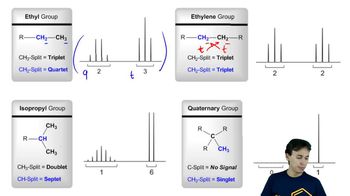
Fragmentation patterns are the specific ways in which a molecule breaks apart into smaller ions during mass spectrometry. Each compound has a unique fragmentation pattern based on its structure, which can be analyzed to deduce the original molecule. Recognizing these patterns is essential for matching the compounds to their respective mass spectra in the given question.
추천 영상:
08:06
Common Splitting Patterns