Ch. 14 - NMR Spectroscopy
Bruice - Organic Chemistry 8th Edition
Bruice8th EditionOrganic ChemistryISBN: 9780135213711당신이 사용하는 게 아니라요?교과서 변경
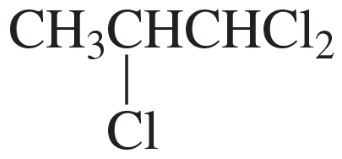
14장, 문제 28i

Describe the 1H NMR spectrum you would expect for each of the following compounds, indicating the relative positions of the signals:
i.

검증된 단계별 안내
1
Analyze the structure of the compound: The molecule is 1-bromo-2-bromopropane. It contains two bromine atoms attached to a propane backbone. The structure has three types of hydrogen environments due to the symmetry and substitution pattern.
Identify the distinct hydrogen environments: (1) The CH3 group at the end of the chain, (2) The CH group attached to the bromine atom, and (3) The CH2 group adjacent to the second bromine atom.
Predict the chemical shifts: (1) The CH3 group hydrogens will appear upfield (low ppm) due to their electron-rich environment, typically around 0.9-1.2 ppm. (2) The CH group hydrogens attached to the bromine will appear downfield (higher ppm) due to the electron-withdrawing effect of bromine, likely around 3.5-4.0 ppm. (3) The CH2 group hydrogens adjacent to the bromine will also appear downfield, but slightly less than the CH group, likely around 2.5-3.0 ppm.
Determine the splitting patterns: (1) The CH3 group hydrogens will be split into a doublet due to coupling with the adjacent CH group. (2) The CH group hydrogen will be split into a quartet due to coupling with the CH3 group and the CH2 group. (3) The CH2 group hydrogens will be split into a triplet due to coupling with the CH group.
Summarize the expected 1H NMR spectrum: The spectrum will show three distinct signals corresponding to the CH3, CH, and CH2 groups. The relative integration will be 3:1:2, reflecting the number of hydrogens in each environment. The chemical shifts and splitting patterns will help identify the structure of the compound.

비슷한 문제에 대한 검증된 영상 답변:

이 영상 해법은 위 문제에 도움이 된다고 튜터들이 추천한 것입니다.
영상 길이:
6m

주요 개념

질문에 올바르게 답하기 위해 반드시 이해해야 하는 핵심 개념들은 다음과 같습니다.

1H NMR Spectroscopy

1H NMR (Proton Nuclear Magnetic Resonance) spectroscopy is a powerful analytical technique used to determine the structure of organic compounds. It provides information about the number of hydrogen atoms in different environments within a molecule, allowing chemists to infer connectivity and functional groups. The resulting spectrum displays peaks corresponding to different hydrogen environments, with their chemical shifts indicating the electronic environment around each hydrogen.
추천 영상:
06:46
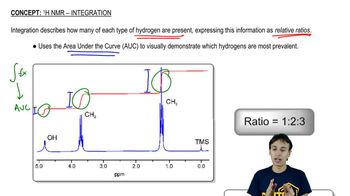
1H NMR Integration

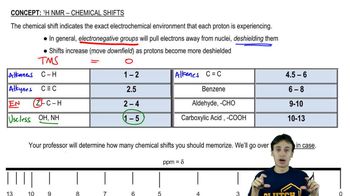
Chemical Shift

Chemical shift refers to the position of a signal in an NMR spectrum, measured in parts per million (ppm). It is influenced by the electronic environment surrounding the hydrogen atoms; for example, hydrogen atoms attached to electronegative atoms (like bromine) will resonate at lower fields (higher ppm) due to deshielding effects. Understanding chemical shifts is crucial for predicting where signals will appear in the spectrum, which aids in identifying the structure of the compound.
추천 영상:
11:44
1H NMR Chemical Shifts

Integration and Multiplicity

Integration in 1H NMR refers to the area under each peak, which correlates to the number of hydrogen atoms contributing to that signal. Multiplicity indicates the splitting pattern of the peaks, which arises from neighboring hydrogen atoms (n+1 rule). For example, a singlet indicates no neighboring hydrogens, while a doublet or triplet suggests one or two neighboring hydrogens, respectively. Together, integration and multiplicity provide insights into the hydrogen environment and connectivity within the molecule.

추천 영상:
06:46
1H NMR Integration