Ch. 15 - Reactions of Carboxylic Acids and Carboxylic Acid Derivatives
Bruice - Organic Chemistry 8th Edition
Bruice8th EditionOrganic ChemistryISBN: 9780135213711당신이 사용하는 게 아니라요?교과서 변경
15장, 문제 7b

b. What is the product of the reaction of acetamide with HO−? The pKa of NH3 is 36; the pKa of H2O is 15.7.

검증된 단계별 안내
1
Identify the functional group in acetamide. Acetamide contains an amide functional group, which is characterized by a carbonyl group (C=O) directly bonded to a nitrogen atom (−NH2).
Understand the role of HO⁻ (hydroxide ion) in the reaction. HO⁻ is a strong base and can deprotonate acidic protons or participate in nucleophilic attack.
Compare the pKa values provided. The pKa of NH3 is 36, and the pKa of H2O is 15.7. Since the pKa of H2O is much lower, it indicates that water is a stronger acid than NH3. This means that the hydroxide ion (conjugate base of H2O) is unlikely to abstract a proton from NH3 (conjugate acid of the amide nitrogen).
Analyze the reaction mechanism. In the presence of HO⁻, the hydroxide ion can attack the carbonyl carbon of the amide group. This is because the carbonyl carbon is electrophilic due to the partial positive charge created by the electronegativity of the oxygen atom.
Predict the product. The nucleophilic attack by HO⁻ on the carbonyl carbon will lead to the cleavage of the C−N bond, resulting in the formation of a carboxylate ion (CH3COO⁻) and ammonia (NH3) as the products of the reaction.

비슷한 문제에 대한 검증된 영상 답변:

이 영상 해법은 위 문제에 도움이 된다고 튜터들이 추천한 것입니다.
영상 길이:
5m

주요 개념

질문에 올바르게 답하기 위해 반드시 이해해야 하는 핵심 개념들은 다음과 같습니다.

Acetamide Structure and Reactivity

Acetamide is an amide derived from acetic acid, featuring a carbonyl group (C=O) bonded to a nitrogen atom (N). Its structure influences its reactivity, particularly in nucleophilic and electrophilic reactions. Understanding how acetamide behaves in the presence of strong bases, like hydroxide ions (HO−), is crucial for predicting the outcome of the reaction.
추천 영상:
01:17
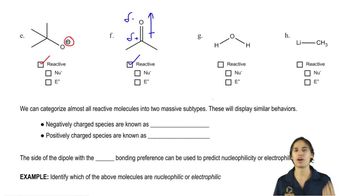
Reactivity of Molecules

Acid-Base Chemistry and pKa Values

The pKa value indicates the strength of an acid in solution; lower pKa values correspond to stronger acids. In this context, the pKa of NH3 (36) suggests it is a very weak acid, while H2O (pKa 15.7) is a much stronger acid. This information is essential for determining the direction of the reaction between acetamide and hydroxide ions, as it helps predict which species will donate or accept protons.
추천 영상:
07:45
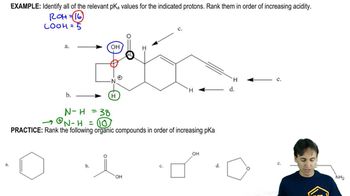
Identifying pKa values

Nucleophilic Attack and Deprotonation

In the reaction of acetamide with hydroxide ions, the hydroxide acts as a strong nucleophile, attacking the carbonyl carbon of acetamide. This leads to the formation of a tetrahedral intermediate, which can subsequently undergo deprotonation. Understanding this mechanism is key to predicting the final product of the reaction, which typically results in the formation of an amine and a hydroxyl group.
추천 영상:
08:27
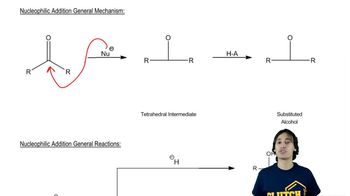
Nucleophilic Addition