Ch. 15 - Reactions of Carboxylic Acids and Carboxylic Acid Derivatives
Bruice - Organic Chemistry 8th Edition
Bruice8th EditionOrganic ChemistryISBN: 9780135213711당신이 사용하는 게 아니라요?교과서 변경
15장, 문제 3g

Draw the structure for each of the following:
g. ethyl 2-chloropentanoate

검증된 단계별 안내
1
Identify the parent chain: The parent chain is 'pentanoate,' which indicates a five-carbon chain with a carboxylic acid derivative (an ester in this case).
Determine the ester group: The 'ethyl' group is attached to the oxygen atom of the ester functional group. This means the structure will have an ethoxy group (-OCH₂CH₃) attached to the carbonyl carbon.
Locate the substituent: The '2-chloro' indicates that a chlorine atom is attached to the second carbon of the pentanoate chain, counting from the carbonyl carbon as position 1.
Assemble the structure: Start with the pentanoate backbone, attach the ethoxy group to the carbonyl carbon, and place the chlorine atom on the second carbon of the chain.
Double-check the structure: Ensure that all carbons have the correct number of bonds (four for each carbon), and verify that the substituents are placed correctly according to the IUPAC name.

비슷한 문제에 대한 검증된 영상 답변:

이 영상 해법은 위 문제에 도움이 된다고 튜터들이 추천한 것입니다.

주요 개념

질문에 올바르게 답하기 위해 반드시 이해해야 하는 핵심 개념들은 다음과 같습니다.

Ester Functional Group

Ester functional groups are characterized by the presence of a carbonyl (C=O) adjacent to an ether (C-O-C) group. They are formed from the reaction of an alcohol and a carboxylic acid, resulting in a compound that typically has pleasant odors and is commonly found in natural and synthetic flavors and fragrances.
추천 영상:
02:36
Identifying Functional Groups

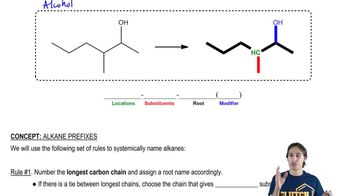
IUPAC Nomenclature

IUPAC nomenclature is a systematic method for naming organic chemical compounds. It provides rules for naming based on the structure of the molecule, including the longest carbon chain, functional groups, and substituents. Understanding these rules is essential for accurately interpreting and constructing chemical names.
추천 영상:
03:43
The different parts of an IUPAC name

Chirality and Stereochemistry

Chirality refers to the geometric property of a molecule having non-superimposable mirror images, often due to the presence of a chiral center, typically a carbon atom bonded to four different substituents. Stereochemistry is the study of these spatial arrangements, which can significantly affect the properties and reactivity of organic compounds.
추천 영상:
가이드 코스
1:21
Polymer Stereochemistry Example 1