Ch. 15 - Reactions of Carboxylic Acids and Carboxylic Acid Derivatives
Bruice - Organic Chemistry 8th Edition
Bruice8th EditionOrganic ChemistryISBN: 9780135213711당신이 사용하는 게 아니라요?교과서 변경
15장, 문제 3i

Draw the structure for each of the following:
i. α-chlorovaleric acid

검증된 단계별 안내
1
Step 1: Understand the name of the compound. The name 'α-chlorovaleric acid' provides key information about the structure. 'Valeric acid' refers to pentanoic acid, which is a carboxylic acid with a five-carbon chain (C5H10O2).
Step 2: Identify the position of the substituent. The prefix 'α-' indicates that the substituent (in this case, a chlorine atom) is attached to the carbon atom directly adjacent to the carboxylic acid group (the α-carbon).
Step 3: Draw the backbone of the molecule. Start with a five-carbon chain, and attach a carboxylic acid group (-COOH) to the first carbon.
Step 4: Add the chlorine substituent. Place a chlorine atom on the α-carbon, which is the second carbon in the chain when counting from the carboxylic acid group.
Step 5: Verify the structure. Ensure that all carbons have the correct number of bonds (four for each carbon) and that the functional groups and substituents are placed correctly according to the IUPAC naming rules.

비슷한 문제에 대한 검증된 영상 답변:

이 영상 해법은 위 문제에 도움이 된다고 튜터들이 추천한 것입니다.

주요 개념

질문에 올바르게 답하기 위해 반드시 이해해야 하는 핵심 개념들은 다음과 같습니다.

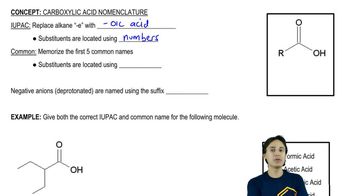
Carboxylic Acids

Carboxylic acids are organic compounds characterized by the presence of a carboxyl group (-COOH). This functional group consists of a carbon atom double-bonded to an oxygen atom and single-bonded to a hydroxyl group (-OH). Carboxylic acids are known for their acidic properties and are commonly found in various biological and industrial processes.
추천 영상:
04:20
Carboxylic Acids Nomenclature

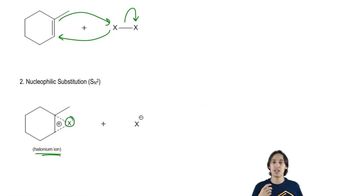
Halogenation

Halogenation is a chemical reaction that involves the introduction of a halogen atom (such as chlorine or bromine) into a molecule. In the context of α-chlorovaleric acid, the halogenation occurs at the alpha position (the first carbon adjacent to the carboxyl group) of valeric acid, resulting in the substitution of a hydrogen atom with a chlorine atom. This process is significant in organic synthesis and can affect the reactivity and properties of the compound.
추천 영상:
03:45
Halogenation Mechanism

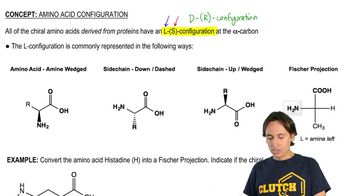
Structural Representation

Structural representation in organic chemistry refers to the way molecules are depicted to convey their arrangement of atoms and bonds. This can include Lewis structures, condensed formulas, or skeletal structures. For α-chlorovaleric acid, accurately drawing its structure involves showing the carboxyl group, the carbon chain of valeric acid, and the chlorine substituent at the appropriate position, which is essential for understanding its chemical behavior.
추천 영상:
05:09
Representations of L-Configuration