Ch. 15 - Reactions of Carboxylic Acids and Carboxylic Acid Derivatives
Bruice - Organic Chemistry 8th Edition
Bruice8th EditionOrganic ChemistryISBN: 9780135213711당신이 사용하는 게 아니라요?교과서 변경
15장, 문제 12e

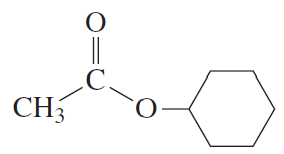
Starting with acetyl chloride, what neutral nucleophile would you use to synthesize each of the following compounds?
e. Chemical structure of acetyl chloride with a nucleophile leading to a cyclic compound.

검증된 단계별 안내
1
Step 1: Identify the functional group in the target compound. The compound contains an ester functional group, specifically ethyl pentyl ester.
Step 2: Recognize that acetyl chloride (CH3COCl) is an acyl chloride, which is reactive and can be converted into an ester through nucleophilic acyl substitution.
Step 3: Determine the neutral nucleophile required to form the ester. To synthesize the target compound, the nucleophile must be cyclopentanol (C5H9OH), as it provides the cyclopentyl group in the ester.
Step 4: Outline the reaction mechanism. Acetyl chloride reacts with cyclopentanol in the presence of a base (such as pyridine) to neutralize the HCl byproduct. The nucleophilic oxygen of cyclopentanol attacks the carbonyl carbon of acetyl chloride, forming the ester bond.
Step 5: Ensure proper reaction conditions. The reaction should be carried out under anhydrous conditions to prevent hydrolysis of acetyl chloride, and a base like pyridine is used to absorb the HCl formed during the reaction.

비슷한 문제에 대한 검증된 영상 답변:

이 영상 해법은 위 문제에 도움이 된다고 튜터들이 추천한 것입니다.
영상 길이:
5m

주요 개념

질문에 올바르게 답하기 위해 반드시 이해해야 하는 핵심 개념들은 다음과 같습니다.

Nucleophilic Acyl Substitution

Nucleophilic acyl substitution is a fundamental reaction in organic chemistry where a nucleophile attacks the carbonyl carbon of an acyl compound, such as an acid chloride, leading to the replacement of a leaving group (like chloride) with the nucleophile. This reaction is crucial for synthesizing various organic compounds, including esters and amides.
추천 영상:
01:47
Nucleophiles and Electrophiles can react in Substitution Reactions.

Acetyl Chloride

Acetyl chloride is an acyl chloride derived from acetic acid, characterized by the presence of a carbonyl group (C=O) and a chlorine atom. It is a reactive electrophile commonly used in organic synthesis to introduce acetyl groups into nucleophiles, facilitating the formation of esters and other derivatives through nucleophilic acyl substitution.
추천 영상:
03:13
Acid Chloride Nomenclature

Neutral Nucleophiles

Neutral nucleophiles are species that possess a lone pair of electrons and can donate them to electrophiles without carrying a formal charge. Examples include alcohols, amines, and water. In the context of nucleophilic acyl substitution, a neutral nucleophile can effectively attack the carbonyl carbon of acetyl chloride, leading to the formation of a new compound.
추천 영상:
08:27
Nucleophilic Addition