Ch. 17 - Reactions at the Alpha-Carbon
Bruice - Organic Chemistry 8th Edition
Bruice8th EditionOrganic ChemistryISBN: 9780135213711당신이 사용하는 게 아니라요?교과서 변경
17장, 문제 19b

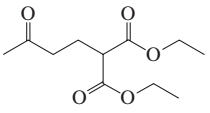
What reagents should be used to prepare the following compounds?
b. Chemical structure illustrating the Michael addition reaction with multiple carbonyl groups and alkyl substituents.

검증된 단계별 안내
1
Step 1: Analyze the target compound. The structure contains two ester groups (-COOCH3), one ketone group (-CO), and a methyl ether (-OCH3). This suggests that the compound could be synthesized using a combination of esterification, aldol condensation, and ether formation reactions.
Step 2: Identify the backbone of the molecule. The central carbon is connected to two carbonyl groups and one methoxy group. This indicates that the molecule could be formed via a reaction involving a β-keto ester synthesis.
Step 3: Plan the synthesis of the β-keto ester. Start with a simple ester, such as methyl acetate (CH3COOCH3), and react it with an enolate formed from acetone (CH3COCH3) in the presence of a base like sodium ethoxide (NaOEt). This will form the β-keto ester intermediate.
Step 4: Introduce the second ester group. React the β-keto ester intermediate with methyl chloroformate (CH3OCOCl) under basic conditions to add the second ester group to the molecule.
Step 5: Add the methoxy group. Use a Williamson ether synthesis to introduce the methoxy group (-OCH3) by reacting the intermediate with methyl iodide (CH3I) in the presence of a strong base like sodium hydride (NaH).

비슷한 문제에 대한 검증된 영상 답변:

이 영상 해법은 위 문제에 도움이 된다고 튜터들이 추천한 것입니다.
영상 길이:
5m

주요 개념

질문에 올바르게 답하기 위해 반드시 이해해야 하는 핵심 개념들은 다음과 같습니다.

Michael Addition

Michael addition is a nucleophilic addition reaction where a nucleophile adds to an α,β-unsaturated carbonyl compound. This reaction typically involves the addition of a carbanion or another nucleophile to the β-carbon of the unsaturated system, forming a new carbon-carbon bond. Understanding this mechanism is crucial for determining the appropriate reagents to synthesize compounds that feature this type of reactivity.
추천 영상:
09:23
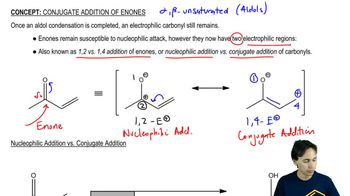
1,2 vs 1,4 Addition

Reagents for Michael Addition

Common reagents for performing a Michael addition include strong bases like sodium hydride (NaH) or lithium diisopropylamide (LDA) to generate the nucleophile, often a stabilized carbanion. Additionally, the α,β-unsaturated carbonyl compound, such as an enone or enal, serves as the electrophile. Identifying the correct combination of these reagents is essential for successfully preparing the desired compound.
추천 영상:
09:23
1,2 vs 1,4 Addition

Functional Groups in Organic Synthesis

Understanding the functional groups present in the target compound is vital for selecting the appropriate synthetic pathway. The compound in the image contains multiple carbonyl groups and an ether, which influence its reactivity and the choice of reagents. Recognizing how these functional groups interact during reactions helps in predicting the outcomes and optimizing the synthesis process.
추천 영상:
02:36
Identifying Functional Groups