Ch. 2 - Acids and Bases: Central to Understanding Organic Chemistry
Bruice - Organic Chemistry 8th Edition
Bruice8th EditionOrganic ChemistryISBN: 9780135213711당신이 사용하는 게 아니라요?교과서 변경
2장, 문제 19c,d

Calculate the equilibrium constant for the acid–base reaction between the reactants in each of the following pairs:
c. CH3NH2 + H2O
d. CH3N+H3 + H2O

검증된 단계별 안내
1
Identify the acid and base in the reaction. For part (c), CH3NH2 (methylamine) acts as a base, and H2O (water) acts as an acid. For part (d), CH3NH3+ (methylammonium ion) acts as an acid, and H2O acts as a base.
Write the chemical equations for the reactions. For part (c), the reaction is CH3NH2 + H2O ⇌ CH3NH3+ + OH⁻. For part (d), the reaction is CH3NH3+ + H2O ⇌ CH3NH2 + H3O⁺.
Determine the equilibrium constant expression (K_eq) for each reaction. For part (c), K_eq = ([CH3NH3+][OH⁻]) / ([CH3NH2][H2O]). For part (d), K_eq = ([CH3NH2][H3O⁺]) / ([CH3NH3+][H2O]).
Simplify the equilibrium constant expressions by recognizing that the concentration of water ([H2O]) is constant in dilute aqueous solutions. This allows you to use the base dissociation constant (K_b) for part (c) and the acid dissociation constant (K_a) for part (d).
Use the relationship between K_a and K_b for conjugate acid-base pairs: K_a × K_b = K_w, where K_w is the ionization constant of water (1.0 × 10⁻¹⁴ at 25°C). If needed, calculate K_a or K_b using this relationship to find the equilibrium constant for the given reactions.

비슷한 문제에 대한 검증된 영상 답변:

이 영상 해법은 위 문제에 도움이 된다고 튜터들이 추천한 것입니다.
영상 길이:
8m
도움이 되었나요?

주요 개념

질문에 올바르게 답하기 위해 반드시 이해해야 하는 핵심 개념들은 다음과 같습니다.

Acid-Base Reactions

Acid-base reactions involve the transfer of protons (H+) between reactants. In these reactions, acids donate protons while bases accept them. Understanding the nature of the reactants, such as whether they are strong or weak acids or bases, is crucial for predicting the direction of the reaction and calculating the equilibrium constant.
추천 영상:
02:49
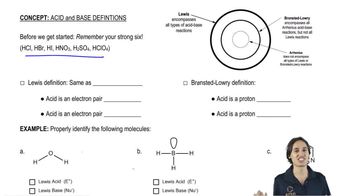
The Lewis definition of acids and bases.

Equilibrium Constant (K)

The equilibrium constant (K) quantifies the ratio of the concentrations of products to reactants at equilibrium for a given reaction. It is calculated using the formula K = [products]/[reactants], where the concentrations are raised to the power of their coefficients in the balanced equation. A higher K value indicates a greater tendency for the reaction to favor products.
추천 영상:
02:19
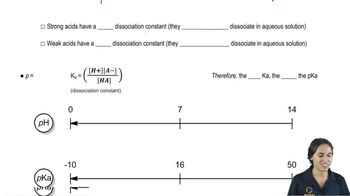
The relationship between equilibrium constant and pKa.

pKa and pKb Values

pKa and pKb values are measures of the strength of acids and bases, respectively. The pKa indicates the acidity of a compound, while pKb indicates the basicity. These values are essential for determining the equilibrium position of acid-base reactions, as they help predict which species will be favored at equilibrium based on their relative strengths.
추천 영상:
07:45
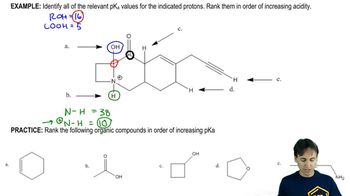
Identifying pKa values