Ch. 2 - Acids and Bases: Central to Understanding Organic Chemistry
Bruice - Organic Chemistry 8th Edition
Bruice8th EditionOrganic ChemistryISBN: 9780135213711당신이 사용하는 게 아니라요?교과서 변경
2장, 문제 55b

Explain the relative acidities.
Chemical structures of three alcohols with their respective acidity constants (Ka) displayed in red text.

검증된 단계별 안내
1
Step 1: Recall that the acidity of a compound is determined by the stability of its conjugate base. A more stable conjugate base corresponds to a stronger acid. In this case, we are comparing the acidities of CCl3CH2OH, CH2ClCH2OH, and CHCl2CH2OH based on their given Ka values.
Step 2: Understand the relationship between Ka and acidity. A higher Ka value indicates a stronger acid because it means the acid dissociates more readily in solution, producing more H+ ions.
Step 3: Analyze the structures of the compounds. The presence of electronegative chlorine atoms in the molecule increases the acidity by stabilizing the conjugate base through an inductive effect. The inductive effect pulls electron density away from the negatively charged oxygen in the conjugate base, making it more stable.
Step 4: Compare the number of chlorine atoms and their positions in each compound. CCl3CH2OH has three chlorine atoms, CHCl2CH2OH has two chlorine atoms, and CH2ClCH2OH has one chlorine atom. The greater the number of chlorine atoms, the stronger the inductive effect, and thus the stronger the acid.
Step 5: Conclude the relative acidities based on the Ka values and the inductive effect. CCl3CH2OH, with the highest Ka value, is the strongest acid, followed by CHCl2CH2OH, and then CH2ClCH2OH, which has the lowest Ka value and is the weakest acid.

비슷한 문제에 대한 검증된 영상 답변:

이 영상 해법은 위 문제에 도움이 된다고 튜터들이 추천한 것입니다.
영상 길이:
7m

주요 개념

질문에 올바르게 답하기 위해 반드시 이해해야 하는 핵심 개념들은 다음과 같습니다.

Acidity and pKa

Acidity refers to the ability of a compound to donate a proton (H+) in solution. The strength of an acid is often expressed in terms of its acid dissociation constant (Ka), with a higher Ka indicating a stronger acid. The pKa, which is the negative logarithm of Ka, provides a more convenient scale for comparing acid strengths; lower pKa values correspond to stronger acids.
추천 영상:
07:45
Identifying pKa values

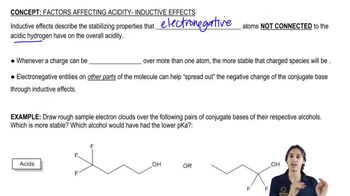
Inductive Effect

The inductive effect describes how the presence of electronegative atoms or groups in a molecule can influence the distribution of electron density. In the context of acidity, electronegative substituents can stabilize the negative charge on the conjugate base formed after deprotonation, thereby increasing the acidity of the original compound. The closer the electronegative group is to the acidic proton, the stronger the inductive effect.
추천 영상:
01:47
Understanding the Inductive Effect.

Comparative Analysis of Compounds

To explain the relative acidities of the given compounds (CCl3CH2OH, CH2ClCH2OH, CHCl2CH2OH), one must analyze the effects of the chlorine substituents on the alcohol functional group. By comparing the number and position of chlorine atoms, one can determine how they influence the stability of the conjugate base and thus the acidity of each compound, with more electronegative substituents generally leading to increased acidity.
추천 영상:
01:40
Defining meso compounds.