Ch. 2 - Acids and Bases: Central to Understanding Organic Chemistry
Bruice - Organic Chemistry 8th Edition
Bruice8th EditionOrganic ChemistryISBN: 9780135213711당신이 사용하는 게 아니라요?교과서 변경
2장, 문제 2a,b

Consider the following reaction: HBr + -C≡N ⇌ Br− + HC≡N
a. What is the acid on the left side of the equation?
b. What is the base on the left side of the equation?

검증된 단계별 안내
1
Step 1: Analyze the reaction provided. The reaction involves HBr and -C≡N on the left side, and Br− and HC≡N on the right side. This is an acid-base reaction where proton transfer occurs.
Step 2: Recall the definition of an acid. According to the Brønsted-Lowry theory, an acid is a species that donates a proton (H⁺). In this case, HBr is donating a proton to -C≡N, making HBr the acid on the left side of the equation.
Step 3: Recall the definition of a base. A base is a species that accepts a proton (H⁺). In this reaction, -C≡N is accepting a proton from HBr, making -C≡N the base on the left side of the equation.
Step 4: Confirm the products formed. When HBr donates a proton, it forms Br−, and when -C≡N accepts a proton, it forms HC≡N. This confirms the acid-base roles of HBr and -C≡N.
Step 5: Summarize the findings. The acid on the left side of the equation is HBr, and the base on the left side of the equation is -C≡N. These roles are determined by their ability to donate and accept protons, respectively.

비슷한 문제에 대한 검증된 영상 답변:

이 영상 해법은 위 문제에 도움이 된다고 튜터들이 추천한 것입니다.
영상 길이:
2m

주요 개념

질문에 올바르게 답하기 위해 반드시 이해해야 하는 핵심 개념들은 다음과 같습니다.

Acid-Base Theory

Acid-base theory explains the behavior of acids and bases in chemical reactions. According to the Brønsted-Lowry theory, an acid is a substance that donates a proton (H+), while a base is a substance that accepts a proton. This framework helps in identifying acids and bases in various chemical reactions, including those involving proton transfer.
추천 영상:
02:49
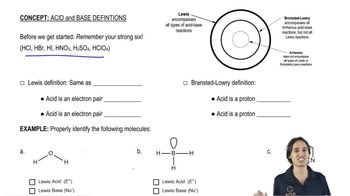
The Lewis definition of acids and bases.

Proton Transfer

Proton transfer is a fundamental process in acid-base reactions where a proton (H+) is transferred from the acid to the base. In the given reaction, HBr donates a proton to the cyanide ion (C≡N), illustrating how the transfer of protons defines the roles of acids and bases in the reaction. Understanding this concept is crucial for identifying the acid and base in the equation.
추천 영상:
03:
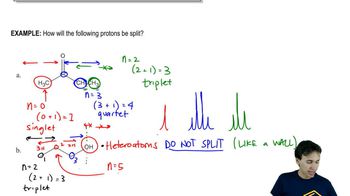
Proton Splitting

Equilibrium in Chemical Reactions

Equilibrium in chemical reactions refers to the state where the rates of the forward and reverse reactions are equal, resulting in constant concentrations of reactants and products. The double arrow in the reaction indicates that it can proceed in both directions, allowing for the identification of acids and bases based on their roles in the forward and reverse processes.
추천 영상:
가이드 코스
3:11
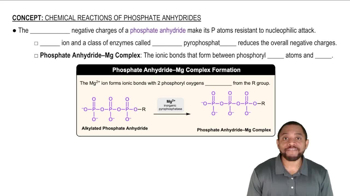
Chemical Reactions of Phosphate Anhydrides Concept 1