Ch. 21 - Amino Acids, Peptides, and Proteins
Bruice - Organic Chemistry 8th Edition
Bruice8th EditionOrganic ChemistryISBN: 9780135213711당신이 사용하는 게 아니라요?교과서 변경
21장, 문제 27

Draw the resonance contributors of the peptide bond in the less stable configuration.

검증된 단계별 안내
1
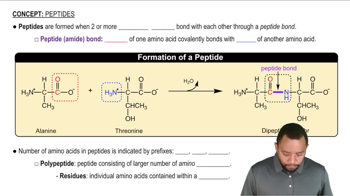
Identify the peptide bond in the given structure. The peptide bond is the amide bond formed between the carbonyl group (C=O) of one amino acid and the amine group (NH) of another amino acid.
Understand that resonance contributors involve the delocalization of electrons. In the peptide bond, the lone pair of electrons on the nitrogen atom can delocalize to form a double bond with the carbon, while the double bond of the carbonyl group shifts to the oxygen atom.
Draw the first resonance structure: The nitrogen atom forms a double bond with the carbon atom, and the oxygen atom of the carbonyl group carries a negative charge due to the shifted electrons. The nitrogen atom will carry a positive charge in this structure.
Draw the second resonance structure: This is the original structure where the carbonyl group has a double bond (C=O), and the nitrogen atom has a lone pair of electrons. This is the more stable configuration due to the full octet on all atoms and the absence of formal charges.
Label the less stable configuration: The resonance structure with the positive charge on nitrogen and the negative charge on oxygen is less stable due to the presence of formal charges and the disruption of the nitrogen's lone pair.

비슷한 문제에 대한 검증된 영상 답변:

이 영상 해법은 위 문제에 도움이 된다고 튜터들이 추천한 것입니다.
영상 길이:
4m

주요 개념

질문에 올바르게 답하기 위해 반드시 이해해야 하는 핵심 개념들은 다음과 같습니다.

Peptide Bond Structure

A peptide bond is a covalent bond formed between the carboxyl group of one amino acid and the amino group of another, resulting in the release of a water molecule. This bond is characterized by a partial double bond character due to resonance, which restricts rotation and contributes to the rigidity of protein structures.
추천 영상:
가이드 코스
3:07
Peptides Concept 1

Resonance Structures

Resonance structures are different Lewis structures for the same molecule that depict the delocalization of electrons. In the case of the peptide bond, resonance allows for the distribution of electron density between the carbonyl oxygen and the nitrogen, influencing the bond's stability and reactivity. Understanding these structures is crucial for predicting molecular behavior.
추천 영상:
03:04
Drawing Resonance Structures

Stability of Resonance Contributors

The stability of resonance contributors is determined by factors such as charge distribution, electronegativity, and the presence of formal charges. Less stable configurations often have higher energy due to unfavorable charge placements or steric hindrance. Analyzing these contributors helps in understanding the reactivity and properties of the peptide bond in different environments.
추천 영상:
03:43
The radical stability trend.