Ch. 21 - Amino Acids, Peptides, and Proteins
Bruice - Organic Chemistry 8th Edition
Bruice8th EditionOrganic ChemistryISBN: 9780135213711당신이 사용하는 게 아니라요?교과서 변경
21장, 문제 63c

Identify the location and type of charge on the hexapeptide Lys-Ser-Asp-Cys-His-Tyr at each of the following pH values:
c. pH=7

검증된 단계별 안내
1
Step 1: Understand the structure of the hexapeptide Lys-Ser-Asp-Cys-His-Tyr. Each amino acid has a side chain with specific functional groups that can gain or lose protons depending on the pH. Additionally, the N-terminus (amino group) and C-terminus (carboxyl group) of the peptide chain are ionizable.
Step 2: Determine the ionization state of the N-terminus and C-terminus at pH 7. The N-terminus (amino group) typically has a pKa around 9-10, meaning it will be protonated and positively charged at pH 7. The C-terminus (carboxyl group) has a pKa around 2-3, meaning it will be deprotonated and negatively charged at pH 7.
Step 3: Analyze the side chains of each amino acid in the hexapeptide at pH 7: Lysine (Lys) has a positively charged amino group (pKa ~10.5), Serine (Ser) has a neutral hydroxyl group, Aspartic acid (Asp) has a negatively charged carboxyl group (pKa ~3.9), Cysteine (Cys) has a neutral thiol group (pKa ~8.3, not ionized at pH 7), Histidine (His) has an imidazole group that is neutral at pH 7 (pKa ~6), and Tyrosine (Tyr) has a neutral phenol group (pKa ~10).
Step 4: Summarize the charges at pH 7: The N-terminus is positively charged, Lysine's side chain is positively charged, Aspartic acid's side chain is negatively charged, and the C-terminus is negatively charged. The side chains of Serine, Cysteine, Histidine, and Tyrosine are neutral at this pH.
Step 5: Assign the location and type of charge: Positive charges are located on the N-terminus and Lysine's side chain. Negative charges are located on the C-terminus and Aspartic acid's side chain. Neutral groups are present on Serine, Cysteine, Histidine, and Tyrosine.

비슷한 문제에 대한 검증된 영상 답변:

이 영상 해법은 위 문제에 도움이 된다고 튜터들이 추천한 것입니다.
영상 길이:
7m

주요 개념

질문에 올바르게 답하기 위해 반드시 이해해야 하는 핵심 개념들은 다음과 같습니다.

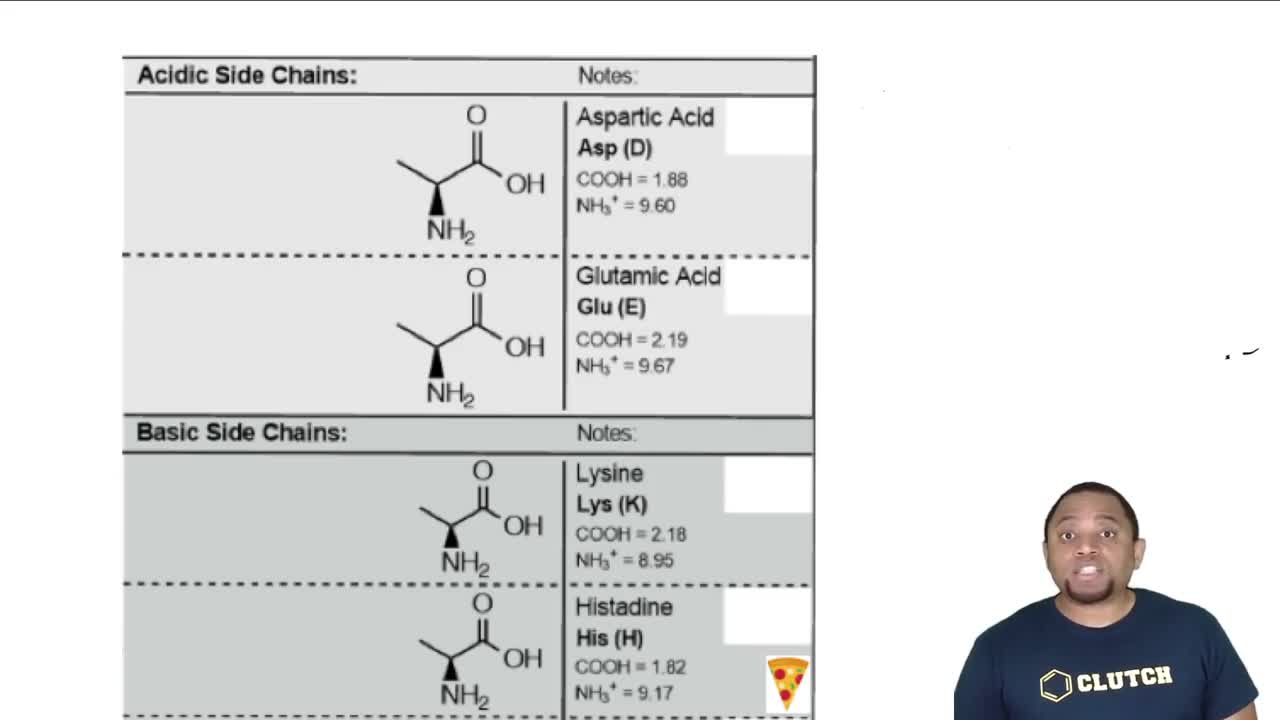
Amino Acid Structure

Amino acids, the building blocks of peptides, have a central carbon atom bonded to an amino group, a carboxyl group, a hydrogen atom, and a variable side chain (R group). The properties of the side chain determine the amino acid's characteristics, including its charge at different pH levels. Understanding the structure of each amino acid in the hexapeptide is crucial for predicting their behavior in solution.
추천 영상:
7:19
Charged Amino Acids

pH and Charge

pH is a measure of the hydrogen ion concentration in a solution, influencing the ionization state of amino acids. At physiological pH (around 7), amino acids can exist in different charged forms depending on their side chains and the ionization of their amino and carboxyl groups. Knowing how pH affects the protonation and deprotonation of functional groups is essential for determining the overall charge of the hexapeptide.
추천 영상:
01:34
Calculating formal and net charge.

Peptide Charge Calculation

The overall charge of a peptide is determined by the sum of the charges of its constituent amino acids. Each amino acid can be positively charged, negatively charged, or neutral depending on the pH. To calculate the charge of the hexapeptide Lys-Ser-Asp-Cys-His-Tyr at pH 7, one must evaluate the ionization states of the side chains and terminal groups of each amino acid, considering their pKa values.
추천 영상:
01:34
Calculating formal and net charge.