Ch. 21 - Amino Acids, Peptides, and Proteins
Bruice - Organic Chemistry 8th Edition
Bruice8th EditionOrganic ChemistryISBN: 9780135213711당신이 사용하는 게 아니라요?교과서 변경
21장, 문제 30

What is the configuration about each of the asymmetric centers in aspartame?

검증된 단계별 안내
1
Identify the asymmetric centers in aspartame. Aspartame is a dipeptide composed of aspartic acid and phenylalanine methyl ester. Look for carbon atoms that are bonded to four different groups, as these are the chiral centers.
Label the asymmetric centers. In aspartame, there are two chiral centers: one in the aspartic acid portion (the α-carbon) and one in the phenylalanine portion (the α-carbon).
Assign priorities to the groups attached to each chiral center using the Cahn-Ingold-Prelog (CIP) priority rules. These rules prioritize groups based on the atomic number of the atoms directly attached to the chiral center. If two atoms are the same, move outward to the next set of atoms until a difference is found.
Determine the configuration (R or S) for each chiral center. Orient the molecule so that the group with the lowest priority is pointing away from you. Then, trace a path from the highest priority group (1) to the second (2) and third (3). If the path is clockwise, the configuration is R; if counterclockwise, it is S.
Repeat the process for both chiral centers in aspartame. Carefully analyze the groups attached to each center and assign the correct configuration for each one.

비슷한 문제에 대한 검증된 영상 답변:

이 영상 해법은 위 문제에 도움이 된다고 튜터들이 추천한 것입니다.
영상 길이:
3m

주요 개념

질문에 올바르게 답하기 위해 반드시 이해해야 하는 핵심 개념들은 다음과 같습니다.

Asymmetric Centers

Asymmetric centers, or chiral centers, are carbon atoms bonded to four different substituents, leading to non-superimposable mirror images known as enantiomers. In organic molecules, the configuration of these centers is crucial for determining the molecule's stereochemistry and biological activity. Understanding how to identify and describe these centers is essential for analyzing compounds like aspartame.
추천 영상:
03:38
How to add to asymmetrical double bonds.

Stereochemistry

Stereochemistry is the study of the spatial arrangement of atoms in molecules and how this arrangement affects their chemical properties and reactions. It encompasses concepts such as chirality, enantiomers, and diastereomers. For aspartame, knowing the stereochemical configuration of its asymmetric centers is vital for understanding its sweetness and interaction with taste receptors.
추천 영상:
가이드 코스
1:38
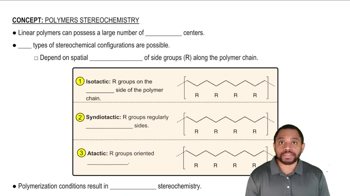
Polymer Stereochemistry Concept 1

Cahn-Ingold-Prelog Priority Rules

The Cahn-Ingold-Prelog (CIP) priority rules are a set of guidelines used to assign priorities to substituents attached to chiral centers based on atomic number and connectivity. These rules help determine the R or S configuration of each asymmetric center. Applying these rules is essential for accurately describing the stereochemistry of aspartame and understanding its molecular behavior.
추천 영상:
01:48
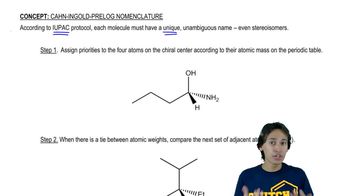
Why stereoisomers need their own naming system.