cis-3,4-Dimethylcyclobutene undergoes thermal ring opening to form the two products shown. One of the products is formed in 99% yield, the other in 1% yield. Which is which?
Ch. 28 - Pericyclic Reactions
24장, 문제 37d
Draw the product of each of the following sigmatropic rearrangements:
d. ![Chemical structure illustrating a [5,5] sigmatropic rearrangement with a benzene ring and a carbon chain.](https://static.studychannel.pearsonprd.tech/courses/organic-chemistry/thumbnails/854fe803-2923-471a-8931-7b3cc94bcf04)
검증된 단계별 안내1
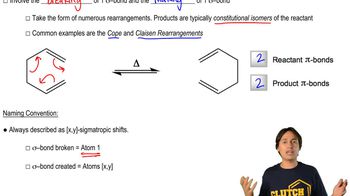
Identify the type of sigmatropic rearrangement involved. Sigmatropic rearrangements are pericyclic reactions where a sigma bond shifts position along with the reorganization of π-electrons. Common examples include [1,3]- and [1,5]-hydrogen shifts, as well as [3,3]-rearrangements like the Claisen or Cope rearrangements.
Determine the numbering of the atoms involved in the rearrangement. For example, in a [3,3]-sigmatropic rearrangement, there are two sets of three atoms connected by a sigma bond, and the rearrangement involves the migration of this sigma bond while maintaining the connectivity of the π-system.
Draw the starting structure and locate the sigma bond that will migrate. Ensure that the π-system (double bonds or lone pairs) is clearly shown, as it plays a crucial role in the rearrangement.
Apply the rearrangement mechanism. For a [3,3]-sigmatropic rearrangement, break the sigma bond and form a new sigma bond between the terminal atoms of the two three-atom units. Simultaneously, adjust the π-bonds to maintain conjugation and satisfy valency rules.
Draw the product structure, ensuring that all atoms are correctly connected and that the new sigma bond and π-system are properly represented. Verify that the product is consistent with the rules of the sigmatropic rearrangement and that no atoms or electrons are lost in the process.

비슷한 문제에 대한 검증된 영상 답변:
이 영상 해법은 위 문제에 도움이 된다고 튜터들이 추천한 것입니다.
주요 개념
질문에 올바르게 답하기 위해 반드시 이해해야 하는 핵심 개념들은 다음과 같습니다.
Sigmatropic Rearrangements
Sigmatropic rearrangements are a class of pericyclic reactions where a sigma bond and a pi bond are rearranged in a concerted manner. These reactions typically involve the migration of a substituent across a double bond, resulting in a structural change of the molecule. Understanding the mechanism and the types of sigmatropic rearrangements, such as [1,3] or [3,3] shifts, is crucial for predicting the products formed.
추천 영상:
Nomenclature of Sigmatropic Shifts
Conservation of Orbital Symmetry
Conservation of orbital symmetry is a principle that states that the symmetry of molecular orbitals must be preserved during a reaction. In sigmatropic rearrangements, this principle helps determine whether a reaction is allowed or forbidden based on the symmetry properties of the involved orbitals. Recognizing the symmetry of the reactants and products is essential for predicting the feasibility of the rearrangement.
추천 영상:
Determining Chirality with Plane of Symmetry
Reaction Mechanism
The reaction mechanism describes the step-by-step process by which reactants are converted into products. For sigmatropic rearrangements, understanding the mechanism involves identifying the transition states and intermediates, as well as the role of electron movement. A clear grasp of the mechanism allows chemists to predict the outcome of the rearrangement and the stability of the resulting products.
추천 영상:
Heck Reaction Mechanism
관련 실천
교과서 질문
123
views
교과서 질문
Propose a mechanism for the following reaction:
767
views
교과서 질문
If the compounds shown here are heated, one will form one product from a [1,3] sigmatropic rearrangement and the other will form two products from two different [1,3] sigmatropic rearrangements. Draw the products of the reactions.
83
views
교과서 질문
Explain why two different products are formed from disrotatory ring closure of (2E,4Z,6Z)-octatriene, but only one product is formed from disrotatory ring closure of (2E,4Z,6E)-octatriene.
145
views
교과서 질문
b. What would be the product if trans-2-butene were used instead of ethene?
989
views
교과서 질문
Draw the product of each of the following sigmatropic rearrangements:
c.
1127
views