

Ch. 28 - Pericyclic Reactions
Bruice - Organic Chemistry 8th Edition
Bruice8th EditionOrganic ChemistryISBN: 9780135213711당신이 사용하는 게 아니라요?교과서 변경
24장, 문제 1

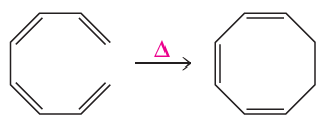
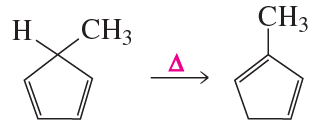
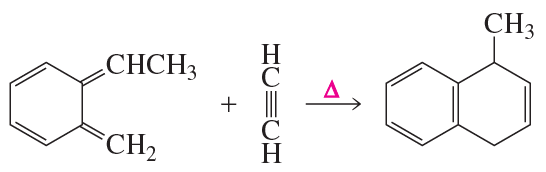
Examine the following pericyclic reactions. For each reaction, tell whether it is an electrocyclic reaction, a cycloaddition reaction, or a sigmatropic rearrangement.
a. Illustration of pericyclic reactions with structures and arrows indicating reaction types.
b. Chemical structure transformation illustrating a pericyclic reaction with reactants on the left and product on the right.
c. Chemical structures illustrating a pericyclic reaction with reactants and products, including a heat symbol.
d. Chemical structures illustrating a pericyclic reaction with reactants and products labeled, including a heat symbol.

검증된 단계별 안내
1
Step 1: Understand the three types of pericyclic reactions. An electrocyclic reaction involves the opening or closing of a conjugated π-system to form a new σ-bond or break an existing one. A cycloaddition reaction involves the formation of a cyclic product by the combination of two π-systems. A sigmatropic rearrangement involves the migration of a σ-bond across a π-system, with the overall connectivity of the molecule remaining unchanged.
Step 2: Analyze reaction (a). Look for changes in the π-system and determine if a new σ-bond is formed (electrocyclic), if two π-systems combine to form a ring (cycloaddition), or if a σ-bond migrates across a π-system (sigmatropic rearrangement).
Step 3: Analyze reaction (b). Use the same criteria as in Step 2 to classify the reaction. Pay attention to the movement of electrons and the formation or breaking of bonds.
Step 4: Analyze reaction (c). Again, determine whether the reaction involves the opening/closing of a π-system (electrocyclic), the combination of two π-systems (cycloaddition), or the migration of a σ-bond (sigmatropic rearrangement).
Step 5: Analyze reaction (d). Follow the same process as in the previous steps to classify the reaction based on the changes in bonding and electron movement.

비슷한 문제에 대한 검증된 영상 답변:

이 영상 해법은 위 문제에 도움이 된다고 튜터들이 추천한 것입니다.

주요 개념

질문에 올바르게 답하기 위해 반드시 이해해야 하는 핵심 개념들은 다음과 같습니다.

Pericyclic Reactions

Pericyclic reactions are a class of organic reactions that occur through a concerted mechanism, involving a cyclic transition state. These reactions typically involve the rearrangement of electrons in a way that conserves orbital symmetry, and they can be classified into three main types: electrocyclic reactions, cycloadditions, and sigmatropic rearrangements.
추천 영상:
07:37
Properties and Types of Pericyclic Reactions

Electrocyclic Reactions

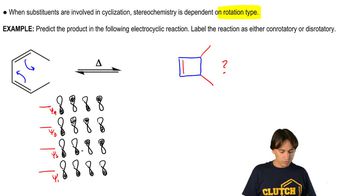
Electrocyclic reactions involve the conversion of a conjugated system into a cyclic structure through the breaking and forming of sigma bonds. These reactions are characterized by the movement of electrons in a way that can be influenced by heat or light, and they follow specific rules based on the number of π electrons involved, as described by the Woodward-Hoffmann rules.
추천 영상:
08:11
Predicting Electrocyclic Products

Cycloaddition Reactions

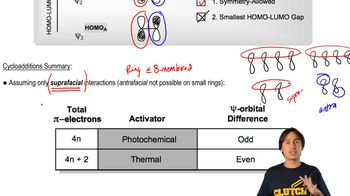
Cycloaddition reactions are a type of pericyclic reaction where two or more unsaturated molecules or fragments combine to form a cyclic product. These reactions can be classified as [2+2] or [4+2] cycloadditions, depending on the number of π bonds involved. The stereochemistry and regioselectivity of these reactions are crucial for determining the structure of the final product.
추천 영상:
08:29
Cycloadditions Summary Chart