Ch. 7 - The Reactions of Alkynes • An Introduction to Multistep Synthesis
Bruice - Organic Chemistry 8th Edition
Bruice8th EditionOrganic ChemistryISBN: 9780135213711당신이 사용하는 게 아니라요?교과서 변경
7장, 문제 20f

What are products of the following reactions?
f.

검증된 단계별 안내
1
Step 1: Identify the type of reaction. The given reaction involves an alkyne reacting with water in the presence of sulfuric acid (H₂SO₄). This is an example of an acid-catalyzed hydration of an alkyne.
Step 2: Understand the mechanism. In acid-catalyzed hydration, the alkyne undergoes electrophilic addition of water, facilitated by the acid catalyst. The reaction typically proceeds via the formation of an enol intermediate, which then tautomerizes to form a ketone.
Step 3: Analyze the structure of the alkyne. The alkyne shown is terminal, meaning the triple bond is at the end of the carbon chain. Terminal alkynes typically form methyl ketones as the major product in acid-catalyzed hydration reactions.
Step 4: Predict the intermediate. The addition of water across the triple bond forms an enol intermediate. The enol has a hydroxyl group (-OH) attached to one of the carbons of the former triple bond, and a double bond between the two carbons.
Step 5: Tautomerization to the final product. The enol intermediate undergoes tautomerization, a process where the hydroxyl group and the double bond rearrange to form a ketone. For this reaction, the final product will be a methyl ketone with the carbonyl group (C=O) on the second carbon of the chain.

비슷한 문제에 대한 검증된 영상 답변:

이 영상 해법은 위 문제에 도움이 된다고 튜터들이 추천한 것입니다.
영상 길이:
3m

주요 개념

질문에 올바르게 답하기 위해 반드시 이해해야 하는 핵심 개념들은 다음과 같습니다.

Reaction Mechanisms

Understanding reaction mechanisms is crucial in organic chemistry as they describe the step-by-step process by which reactants transform into products. This includes identifying intermediates, transition states, and the movement of electrons. Familiarity with mechanisms helps predict the outcome of reactions and the stability of products formed.
추천 영상:
02:16
Heck Reaction Mechanism

Functional Groups

Functional groups are specific groups of atoms within molecules that are responsible for the characteristic chemical reactions of those molecules. Recognizing functional groups allows chemists to predict reactivity and the types of products that can be formed in a reaction. Common functional groups include alcohols, carboxylic acids, and amines.
추천 영상:
02:36
Identifying Functional Groups

Stoichiometry

Stoichiometry involves the calculation of reactants and products in chemical reactions. It is essential for determining the amounts of substances consumed and produced, ensuring that the law of conservation of mass is upheld. Mastery of stoichiometry allows chemists to balance equations and predict yields of reactions.
추천 영상:
02:08
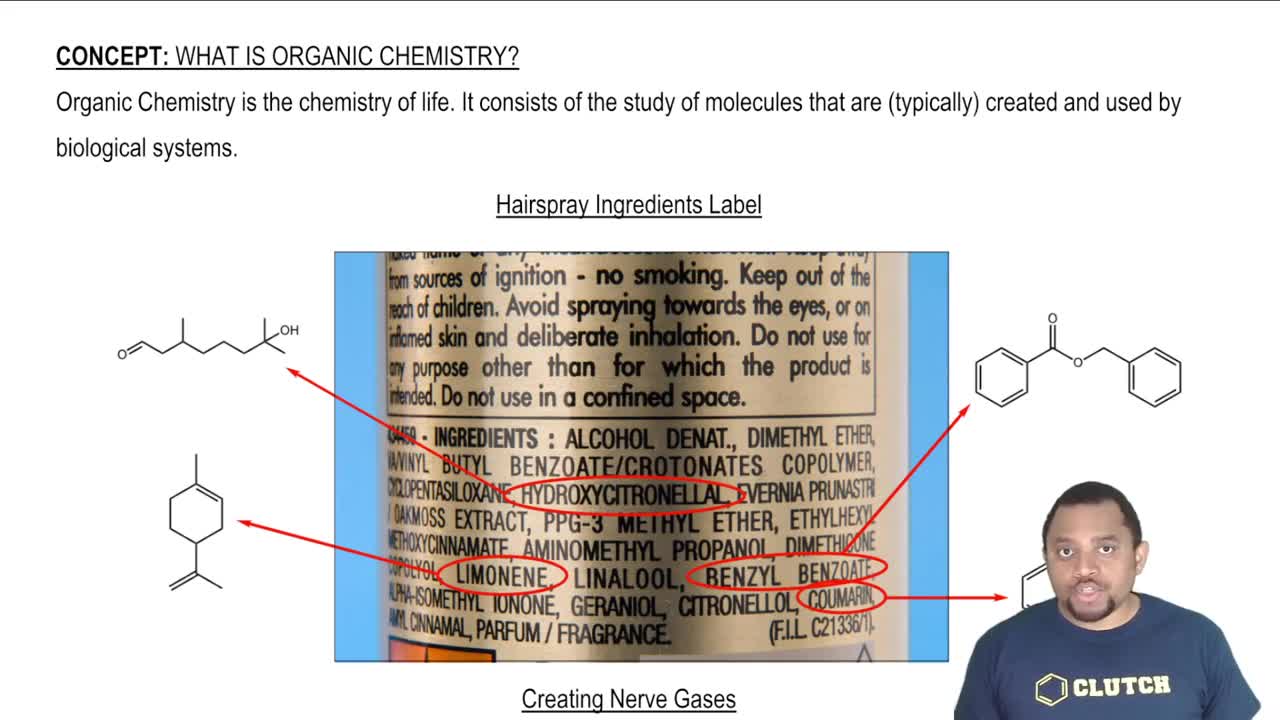
Organic molecules in your everyday life.