Ch. 8 - Delocalized Electrons: Their Effect on Stability, pKa, and the Products of a Reaction • Aromaticity and Electronic Effects: An Introduction to the Reactions of Benzene
Bruice - Organic Chemistry 8th Edition
Bruice8th EditionOrganic ChemistryISBN: 9780135213711당신이 사용하는 게 아니라요?교과서 변경
8장, 문제 104

As many as 18 different Diels–Alder products can be obtained by heating a mixture of 1,3-butadiene and 2-methyl-1,3-butadiene. Identify the products.

검증된 단계별 안내
1
Step 1: Recall the Diels–Alder reaction mechanism, which involves a [4+2] cycloaddition between a conjugated diene (4 π-electrons) and a dienophile (2 π-electrons). In this case, both 1,3-butadiene and 2-methyl-1,3-butadiene can act as dienes.
Step 2: Consider the possible combinations of the two dienes. Since both 1,3-butadiene and 2-methyl-1,3-butadiene can react with themselves (homo-dimerization) or with each other (cross-dimerization), there are multiple possible products.
Step 3: For each combination, draw the possible regioisomers. For example, when 1,3-butadiene reacts with 2-methyl-1,3-butadiene, consider the orientation of the substituents (e.g., the methyl group) and how they affect the product's structure.
Step 4: Account for stereoisomers. The Diels–Alder reaction is stereospecific, meaning the stereochemistry of the diene and dienophile is preserved in the product. For each regioisomer, determine the possible stereoisomers (e.g., endo and exo products).
Step 5: Summarize the total number of products by combining all regioisomers and stereoisomers from the homo-dimerization and cross-dimerization reactions. Ensure that you have considered all possible combinations and orientations.

비슷한 문제에 대한 검증된 영상 답변:

이 영상 해법은 위 문제에 도움이 된다고 튜터들이 추천한 것입니다.
영상 길이:
9m

주요 개념

질문에 올바르게 답하기 위해 반드시 이해해야 하는 핵심 개념들은 다음과 같습니다.

Diels–Alder Reaction

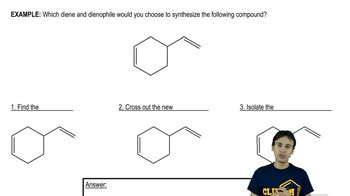
The Diels–Alder reaction is a [4+2] cycloaddition reaction between a conjugated diene and a dienophile, resulting in the formation of a six-membered ring. This reaction is a key method in organic synthesis for constructing complex cyclic structures and is characterized by its stereospecificity and regioselectivity.
추천 영상:
04:02
Diels-Alder Retrosynthesis

Conjugated Dienes

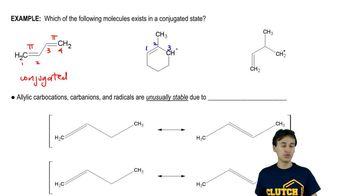
Conjugated dienes, such as 1,3-butadiene, contain alternating double and single bonds, which allow for greater stability and reactivity in cycloaddition reactions. The electron-rich nature of these compounds makes them excellent reactants in Diels–Alder reactions, facilitating the formation of new carbon-carbon bonds.
추천 영상:
03:27
Conjugated states

Regioselectivity and Stereochemistry

Regioselectivity refers to the preference of a chemical reaction to yield one structural isomer over others, while stereochemistry involves the spatial arrangement of atoms in molecules. In the Diels–Alder reaction, both factors play a crucial role in determining the specific products formed, as different orientations and positions of substituents can lead to a variety of distinct products.
추천 영상:
가이드 코스
1:38
Polymer Stereochemistry Concept 1