Ch. 9 - Substitution and Elimination Reactions of Alkyl Halides
Bruice - Organic Chemistry 8th Edition
Bruice8th EditionOrganic ChemistryISBN: 9780135213711당신이 사용하는 게 아니라요?교과서 변경
9장, 문제 35b

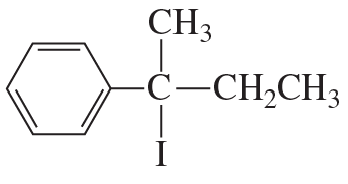
What is the major product formed when the following compounds undergo an E1 reaction?
b. Chemical structure showing a benzene ring connected to a carbon chain with an iodine atom and two alkyl groups.

검증된 단계별 안내
1
Step 1: Understand the E1 reaction mechanism. E1 reactions are unimolecular elimination reactions where the rate-determining step involves the formation of a carbocation intermediate. This typically occurs in the presence of a weak base and a polar protic solvent.
Step 2: Identify the leaving group in the given compound. The leaving group must be able to depart easily, forming a stable carbocation intermediate. Common leaving groups include halides (e.g., Cl⁻, Br⁻, I⁻) or sulfonates (e.g., OTs).
Step 3: Analyze the stability of the carbocation intermediate formed after the leaving group departs. Carbocation stability follows the order: tertiary > secondary > primary > methyl. If resonance stabilization is possible, it further enhances carbocation stability.
Step 4: Determine the major product by considering the most substituted alkene formed via the elimination of a proton from a β-hydrogen. This follows Zaitsev's rule, which states that the more substituted alkene is generally the major product.
Step 5: Consider any rearrangements that might occur. If the initially formed carbocation can rearrange to a more stable carbocation (e.g., via hydride or alkyl shifts), this rearrangement will influence the final product.

비슷한 문제에 대한 검증된 영상 답변:

이 영상 해법은 위 문제에 도움이 된다고 튜터들이 추천한 것입니다.
영상 길이:
1m

주요 개념

질문에 올바르게 답하기 위해 반드시 이해해야 하는 핵심 개념들은 다음과 같습니다.

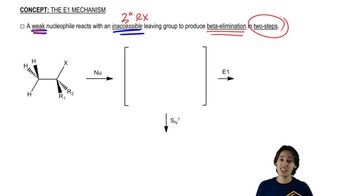
E1 Reaction Mechanism

The E1 reaction mechanism is a type of elimination reaction that occurs in two distinct steps. The first step involves the formation of a carbocation intermediate through the loss of a leaving group, while the second step involves the deprotonation of a neighboring carbon to form a double bond. This mechanism is favored in polar protic solvents and typically occurs with tertiary or some secondary substrates due to their ability to stabilize the carbocation.
추천 영상:
08:09
Drawing the E1 Mechanism.

Carbocation Stability

Carbocation stability is a crucial factor in determining the outcome of E1 reactions. Carbocations are positively charged species that can vary in stability based on their structure; tertiary carbocations are more stable than secondary, which are more stable than primary. The stability is influenced by factors such as hyperconjugation and inductive effects from adjacent alkyl groups, which can help to stabilize the positive charge.
추천 영상:
05:58
Determining Carbocation Stability

Regioselectivity in Elimination Reactions

Regioselectivity refers to the preference of a chemical reaction to yield one structural isomer over others when multiple products are possible. In E1 reactions, the major product often results from the most stable alkene, which is determined by the Zaitsev's rule, stating that the more substituted alkene is favored. Understanding regioselectivity is essential for predicting the major product formed in elimination reactions.
추천 영상:
00:40
Recognizing Elimination Reactions.