Ch. 10 - Alkynes: Electrophilic Addition and Redox Reactions
Mullins - Organic Chemistry: A Learner Centered Approach 1st Edition
Mullins1st EditionOrganic Chemistry: A Learner Centered ApproachISBN: 9780137566471당신이 사용하는 게 아니라요?교과서 변경
9장, 문제 9a

Draw the structures that correspond to the following IUPAC names.
(a) (R)-4-isopropyl-6-methylhept-2-yne

검증된 단계별 안내
1
Step 1: Break down the IUPAC name into its components. The name '(R)-4-isopropyl-6-methylhept-2-yne' indicates: (a) 'hept' as the parent chain, meaning it has 7 carbon atoms, (b) '2-yne' indicates a triple bond starting at carbon 2, (c) substituents '4-isopropyl' and '6-methyl' are attached to the parent chain, and (d) the '(R)' configuration specifies the stereochemistry at carbon 4.
Step 2: Draw the parent chain. Start with a straight chain of 7 carbon atoms (heptane). Add a triple bond between carbons 2 and 3 to represent the '2-yne' functional group.
Step 3: Add the substituents. Attach an isopropyl group (a branched group with the structure CH(CH3)2) to carbon 4 and a methyl group (CH3) to carbon 6 of the parent chain.
Step 4: Assign the stereochemistry. The '(R)' configuration at carbon 4 means you need to prioritize the groups attached to this carbon based on the Cahn-Ingold-Prelog rules. Arrange the groups in 3D space and ensure the configuration matches the '(R)' designation.
Step 5: Verify the structure. Double-check that the parent chain, triple bond, substituents, and stereochemistry are all correctly represented in the final structure.

비슷한 문제에 대한 검증된 영상 답변:

이 영상 해법은 위 문제에 도움이 된다고 튜터들이 추천한 것입니다.
영상 길이:
3m

주요 개념

질문에 올바르게 답하기 위해 반드시 이해해야 하는 핵심 개념들은 다음과 같습니다.

IUPAC Nomenclature

IUPAC nomenclature is a systematic method for naming organic chemical compounds. It provides a set of rules to derive the name from the structure, ensuring that each compound has a unique and descriptive name. Understanding the nomenclature rules, such as identifying the longest carbon chain and substituents, is essential for accurately interpreting and drawing chemical structures.
추천 영상:
03:43
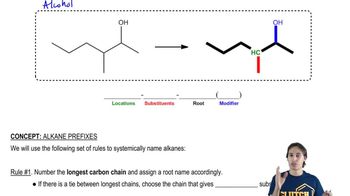
The different parts of an IUPAC name

Stereochemistry

Stereochemistry refers to the study of the spatial arrangement of atoms in molecules and how this affects their chemical behavior. The designation of (R) or (S) in a compound indicates its specific three-dimensional configuration around a chiral center. Recognizing stereochemical descriptors is crucial for drawing the correct structure, especially when dealing with chiral compounds.
추천 영상:
가이드 코스
1:38
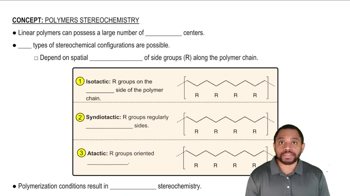
Polymer Stereochemistry Concept 1

Alkynes

Alkynes are a class of hydrocarbons characterized by at least one carbon-carbon triple bond. They are unsaturated compounds and can exhibit unique reactivity due to the presence of this triple bond. Understanding the structure and properties of alkynes, including how to represent them in structural formulas, is vital for accurately drawing compounds like (R)-4-isopropyl-6-methylhept-2-yne.
추천 영상:
09:11
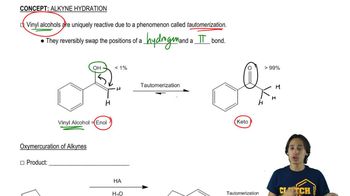
Alkyne Hydration