Ch. 10 - Alkynes: Electrophilic Addition and Redox Reactions
Mullins - Organic Chemistry: A Learner Centered Approach 1st Edition
Mullins1st EditionOrganic Chemistry: A Learner Centered ApproachISBN: 9780137566471당신이 사용하는 게 아니라요?교과서 변경
9장, 문제 44c(ii)

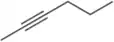
For the alkynes shows here, show the product(s) expected to form when treated under the following conditions: (ii) H2, Pd/C, Pb(OAc)2 , CaCO3 (Lindlar's catalyst). If you expect two products, show both.
(c) Diagram of alkynes showing expected products from hydrogenation with H₂ and Pd/C catalyst.

검증된 단계별 안내
1
Identify the starting alkyne structure. Alkynes are hydrocarbons containing a carbon-carbon triple bond (C≡C). Determine whether the alkyne is terminal (triple bond at the end of the chain) or internal (triple bond within the chain).
Understand the reaction conditions: H₂ with Lindlar's catalyst (Pd/C, Pb(OAc)₂, CaCO₃) is a selective hydrogenation process. It reduces alkynes to *cis-alkenes* by adding one equivalent of hydrogen (H₂) across the triple bond in a syn-addition manner.
Draw the intermediate product: Replace the triple bond (C≡C) with a double bond (C=C) and ensure that the two substituents on the carbons of the double bond are on the same side (cis configuration).
If the alkyne is internal and symmetrical, only one product will form. If the alkyne is internal and asymmetrical, consider the possibility of forming two different cis-alkenes depending on the substituents attached to the triple bond.
Verify the stereochemistry of the product(s): Ensure that the resulting alkene(s) have the correct cis configuration and that no further reduction occurs, as Lindlar's catalyst prevents over-reduction to an alkane.

비슷한 문제에 대한 검증된 영상 답변:

이 영상 해법은 위 문제에 도움이 된다고 튜터들이 추천한 것입니다.
영상 길이:
2m

주요 개념

질문에 올바르게 답하기 위해 반드시 이해해야 하는 핵심 개념들은 다음과 같습니다.

Alkynes

Alkynes are hydrocarbons that contain at least one carbon-carbon triple bond. They are unsaturated compounds and can undergo various reactions, including hydrogenation, where the triple bond is converted to a double or single bond. Understanding the structure and reactivity of alkynes is crucial for predicting the products of their reactions.
추천 영상:
09:11
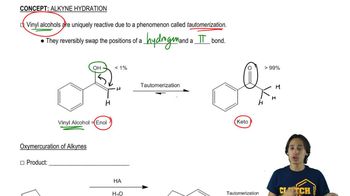
Alkyne Hydration

Lindlar's Catalyst

Lindlar's catalyst is a poisoned palladium catalyst used to selectively hydrogenate alkynes to cis-alkenes. It consists of palladium supported on calcium carbonate and treated with lead acetate, which reduces its activity. This selectivity is important in organic synthesis, as it allows for the formation of specific isomers without fully saturating the alkyne.
추천 영상:
가이드 코스
2:10
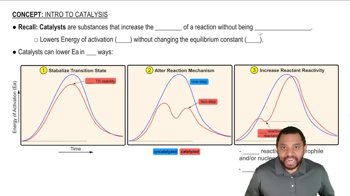
Introduction to Catalysis Concept 1

Hydrogenation Reaction

Hydrogenation is a chemical reaction that involves the addition of hydrogen (H₂) to a compound, typically in the presence of a catalyst. In the case of alkynes, hydrogenation can lead to the formation of alkenes or alkanes, depending on the conditions and the catalyst used. Understanding the mechanism and conditions of hydrogenation is essential for predicting the products formed in reactions involving alkynes.
추천 영상:
가이드 코스
3:55
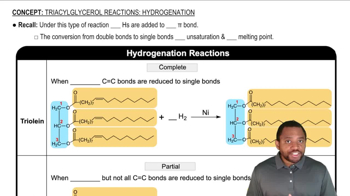
Triacylglycerol Reactions: Hydrogenation Concept 1