Ch. 11 - Properties and Synthesis of Alkyl Halides: Radical Reactions
Mullins - Organic Chemistry: A Learner Centered Approach 1st Edition
Mullins1st EditionOrganic Chemistry: A Learner Centered ApproachISBN: 9780137566471당신이 사용하는 게 아니라요?교과서 변경
10장, 문제 9a

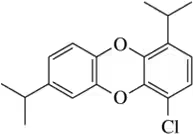
Classify the following molecules as hydrophilic, hydrophobic, lipophilic, or lipophobic. Each molecule should have two classifications.
(a)

검증된 단계별 안내
1
Step 1: Understand the definitions of the terms hydrophilic, hydrophobic, lipophilic, and lipophobic. Hydrophilic refers to molecules that interact well with water (water-loving), while hydrophobic refers to molecules that repel water (water-fearing). Lipophilic refers to molecules that dissolve well in lipids or fats (fat-loving), and lipophobic refers to molecules that repel lipids or fats (fat-fearing).
Step 2: Analyze the structure of the given molecule. Look for functional groups or structural features that indicate polarity or non-polarity. Polar molecules (e.g., those with hydroxyl (-OH), carboxyl (-COOH), or amino (-NH2) groups) are typically hydrophilic and lipophobic, while non-polar molecules (e.g., hydrocarbons or molecules with long alkyl chains) are typically hydrophobic and lipophilic.
Step 3: Determine the molecule's solubility in water. If the molecule has polar functional groups, it is likely hydrophilic. If it lacks polar groups and consists mostly of non-polar bonds, it is likely hydrophobic.
Step 4: Assess the molecule's solubility in lipids or fats. Non-polar molecules tend to dissolve well in lipids, making them lipophilic. Polar molecules, on the other hand, are generally lipophobic.
Step 5: Assign two classifications to the molecule based on its structural features and solubility properties. For example, a molecule with both polar and non-polar regions may exhibit dual characteristics, such as being hydrophilic and lipophilic.

비슷한 문제에 대한 검증된 영상 답변:

이 영상 해법은 위 문제에 도움이 된다고 튜터들이 추천한 것입니다.
영상 길이:
2m

주요 개념

질문에 올바르게 답하기 위해 반드시 이해해야 하는 핵심 개념들은 다음과 같습니다.

Hydrophilicity and Hydrophobicity

Hydrophilicity refers to the affinity of a molecule for water, often due to the presence of polar functional groups that can form hydrogen bonds with water. Conversely, hydrophobicity describes molecules that repel water, typically nonpolar substances that do not interact favorably with water molecules. Understanding these properties is crucial for predicting how molecules behave in aqueous environments.
추천 영상:
가이드 코스
2:00
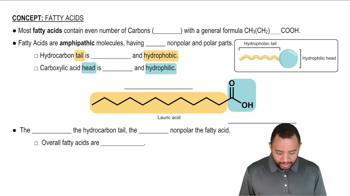
Fatty Acids Concept 1

Lipophilicity and Lipophobicity

Lipophilicity indicates a molecule's affinity for lipids or fats, often associated with nonpolar characteristics that allow for solubility in organic solvents. In contrast, lipophobicity describes molecules that do not interact well with lipids, usually due to polar or charged functional groups. These classifications are essential for understanding the behavior of molecules in biological membranes and their interactions with lipids.

Functional Groups and Molecular Polarity

Functional groups are specific groups of atoms within molecules that determine their chemical reactivity and properties, including polarity. The polarity of a molecule is influenced by the presence of electronegative atoms (like oxygen or nitrogen) and the overall molecular structure. Recognizing functional groups helps in classifying molecules as hydrophilic or hydrophobic, and lipophilic or lipophobic, based on their interactions with water and lipids.
추천 영상:
02:36
Identifying Functional Groups