Ch. 12 - Substitution and Elimination: Reactions of Haloalkanes
Mullins - Organic Chemistry: A Learner Centered Approach 1st Edition
Mullins1st EditionOrganic Chemistry: A Learner Centered ApproachISBN: 9780137566471당신이 사용하는 게 아니라요?교과서 변경
11장, 문제 28a

For each solvent, indicate the most likely substitution reaction to take place.
(a)

검증된 단계별 안내
1
Analyze the solvent structure provided in the image. The solvent shown is dimethoxyethane (DME), which is an aprotic solvent.
Understand the role of the solvent in substitution reactions. Aprotic solvents favor SN2 reactions because they do not stabilize the nucleophile, allowing it to remain reactive.
Consider the mechanism of SN2 reactions. SN2 reactions involve a single-step process where the nucleophile attacks the electrophilic carbon and displaces the leaving group simultaneously.
Evaluate the conditions under which SN2 reactions are favored. These include a strong nucleophile, a primary or secondary alkyl halide, and an aprotic solvent like DME.
Conclude that in the presence of dimethoxyethane (DME), the most likely substitution reaction to take place is an SN2 reaction due to the solvent's properties and its ability to support a strong nucleophile.

비슷한 문제에 대한 검증된 영상 답변:

이 영상 해법은 위 문제에 도움이 된다고 튜터들이 추천한 것입니다.

주요 개념

질문에 올바르게 답하기 위해 반드시 이해해야 하는 핵심 개념들은 다음과 같습니다.

Nucleophilic Substitution Reactions

Nucleophilic substitution reactions involve the replacement of a leaving group in a molecule by a nucleophile. These reactions can occur via two main mechanisms: SN1, which is a two-step process involving carbocation formation, and SN2, which is a one-step process where the nucleophile attacks the substrate simultaneously as the leaving group departs. The choice of mechanism often depends on the structure of the substrate and the nature of the nucleophile.
추천 영상:
01:47
Nucleophiles and Electrophiles can react in Substitution Reactions.

Solvent Effects on Reaction Mechanisms

The choice of solvent can significantly influence the rate and mechanism of nucleophilic substitution reactions. Polar protic solvents stabilize ions and favor SN1 mechanisms by stabilizing the carbocation intermediate, while polar aprotic solvents enhance the nucleophilicity of the nucleophile and favor SN2 mechanisms. Understanding the solvent's properties is crucial for predicting the outcome of substitution reactions.
추천 영상:
02:26
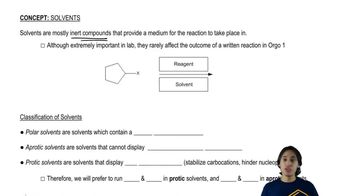
General format of reactions and how to interpret solvents.

Leaving Group Ability

The ability of a leaving group to depart from a substrate is a critical factor in nucleophilic substitution reactions. Good leaving groups, such as halides or sulfonate esters, can stabilize the negative charge they acquire upon leaving, facilitating the reaction. Conversely, poor leaving groups can hinder the reaction, making it essential to evaluate the leaving group's strength when predicting the reaction pathway.
추천 영상:
03:06
How to use the factors affecting acidity to predict leaving group ability.