Ch. 12 - Substitution and Elimination: Reactions of Haloalkanes
Mullins - Organic Chemistry: A Learner Centered Approach 1st Edition
Mullins1st EditionOrganic Chemistry: A Learner Centered ApproachISBN: 9780137566471당신이 사용하는 게 아니라요?교과서 변경
11장, 문제 27

The following reaction, though run under standard solvolysis conditions, occurs via an SN2 reaction. Why?

검증된 단계별 안내
1
Analyze the structure of the substrate: The substrate is a benzyl chloride derivative. Benzyl groups are known to stabilize carbocations due to resonance, which typically favors an SN1 mechanism. However, the stereochemistry of the product suggests an SN2 reaction.
Examine the stereochemistry of the product: The reaction results in an inversion of configuration at the carbon attached to the chlorine atom. This inversion is a hallmark of the SN2 mechanism, where the nucleophile attacks from the opposite side of the leaving group.
Consider the reaction conditions: The reaction is run under solvolysis conditions (CH3OH as the solvent and nucleophile). While solvolysis often favors SN1 reactions, the steric and electronic factors of the substrate can override this preference.
Evaluate steric hindrance: The carbon attached to the chlorine atom is a primary carbon. Primary carbons are less sterically hindered, making them more accessible to a nucleophile for a direct backside attack, which is characteristic of the SN2 mechanism.
Assess the role of the benzyl group: Although the benzyl group can stabilize a carbocation (favoring SN1), the primary nature of the carbon and the stereochemical outcome strongly suggest that the reaction proceeds via an SN2 pathway instead.

비슷한 문제에 대한 검증된 영상 답변:

이 영상 해법은 위 문제에 도움이 된다고 튜터들이 추천한 것입니다.

주요 개념

질문에 올바르게 답하기 위해 반드시 이해해야 하는 핵심 개념들은 다음과 같습니다.

S<sub>N</sub>2 Mechanism

The S<sub>N</sub>2 mechanism is a type of nucleophilic substitution reaction where the nucleophile attacks the electrophile from the opposite side of the leaving group, resulting in a concerted reaction. This mechanism typically occurs with primary or secondary substrates and involves a single transition state. The stereochemistry is inverted at the carbon center where substitution occurs, which is crucial for understanding the reaction's outcome.
추천 영상:
05:29
Creating Ribonucleosides

Solvolysis

Solvolysis refers to a chemical reaction in which the solvent acts as a nucleophile, leading to the substitution of a leaving group in a substrate. In organic chemistry, this often involves polar protic solvents like alcohols or water. While solvolysis reactions can proceed via S<sub>N</sub>1 or S<sub>N</sub>2 mechanisms, the presence of a strong nucleophile and specific substrate structure can favor an S<sub>N</sub>2 pathway even under typical solvolysis conditions.
추천 영상:
08:16
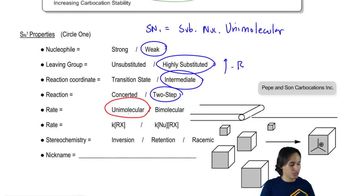
Understanding the properties of SN1.

Steric Hindrance

Steric hindrance refers to the prevention of chemical reactions due to the spatial arrangement of atoms within a molecule. In the context of nucleophilic substitution, bulky groups near the reactive site can impede the approach of the nucleophile, favoring an S<sub>N</sub>2 mechanism over S<sub>N</sub>1. In this reaction, the presence of sterically hindered groups can influence the pathway taken, making it essential to consider when predicting reaction outcomes.
추천 영상:
02:53
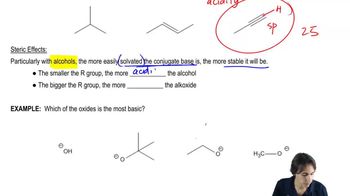
Understanding steric effects.