Ch. 13 - Alcohols, Ethers and Related Compounds: Substitution and Elimination
Mullins - Organic Chemistry: A Learner Centered Approach 1st Edition
Mullins1st EditionOrganic Chemistry: A Learner Centered ApproachISBN: 9780137566471당신이 사용하는 게 아니라요?교과서 변경
12장, 문제 72

Draw a reaction coordinate diagram for the acid-catalyzed addition of an alcohol to an alkene. Which step is rate-determining?

검증된 단계별 안내
1
Start by understanding the mechanism of the acid-catalyzed addition of an alcohol to an alkene. This reaction typically involves the formation of a carbocation intermediate.
Identify the key steps in the mechanism: protonation of the alkene to form a carbocation, nucleophilic attack by the alcohol, and deprotonation to form the final ether product.
Draw the reaction coordinate diagram. The x-axis represents the reaction progress, while the y-axis represents the energy. Begin with the reactants at a certain energy level.
Illustrate the energy changes for each step: the initial protonation step usually has a high energy barrier, forming the carbocation intermediate, which is often the highest energy point in the diagram.
Determine the rate-determining step. This is typically the step with the highest energy barrier, which is often the formation of the carbocation intermediate in this type of reaction.

비슷한 문제에 대한 검증된 영상 답변:

이 영상 해법은 위 문제에 도움이 된다고 튜터들이 추천한 것입니다.
영상 길이:
12m

주요 개념

질문에 올바르게 답하기 위해 반드시 이해해야 하는 핵심 개념들은 다음과 같습니다.

Reaction Coordinate Diagram

A reaction coordinate diagram visually represents the energy changes during a chemical reaction. It plots the energy of the system against the progress of the reaction, illustrating the transition states and intermediates. The peaks correspond to transition states, while valleys represent stable intermediates. This diagram helps in understanding the energy barriers and the overall thermodynamics of the reaction.
추천 영상:
05:02
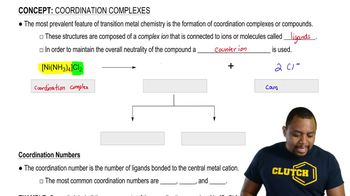
Coordination Complexes

Acid-Catalyzed Reaction Mechanism

In acid-catalyzed reactions, an acid donates a proton (H+) to facilitate the reaction, often enhancing the electrophilicity of the alkene. This mechanism typically involves the formation of a carbocation intermediate, which is more reactive towards nucleophiles, such as alcohols. Understanding this mechanism is crucial for predicting the reaction pathway and the stability of intermediates formed during the process.
추천 영상:
06:34
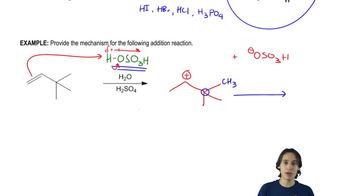
Acid-catalyzed hydration mechanism

Rate-Determining Step

The rate-determining step (RDS) is the slowest step in a reaction mechanism that dictates the overall reaction rate. It often involves the highest energy transition state and is crucial for understanding the kinetics of the reaction. Identifying the RDS allows chemists to focus on the most significant barriers to reaction progress, which is essential for optimizing reaction conditions and yields.
추천 영상:
가이드 코스
5:07
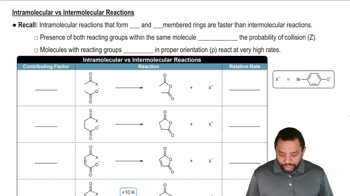
Rates of Intramolecular Reactions Concept 2