Why is the SN1 reaction shown an inefficient way of synthesizing ethers?
Ch. 13 - Alcohols, Ethers and Related Compounds: Substitution and Elimination

Mullins1st EditionOrganic Chemistry: A Learner Centered ApproachISBN: 9780137566471당신이 사용하는 게 아니라요?교과서 변경
모든 교과서
Mullins 1st Edition
Ch. 13 - Alcohols, Ethers and Related Compounds: Substitution and Elimination
문제 70
Mullins 1st Edition
Ch. 13 - Alcohols, Ethers and Related Compounds: Substitution and Elimination
문제 7012장, 문제 70
How could the reaction in Figure 13.67(b) be modified to produce the following ether?

검증된 단계별 안내1
Identify the ether product structure: The ether shown in the image is a cyclic ether with a cyclopentyl group and a branched alkyl chain.
Determine the starting materials: To form an ether, you typically need an alcohol and an alkyl halide. In this case, identify the two parts of the ether that could come from these starting materials.
Select the appropriate alcohol: The oxygen atom in the ether is typically derived from the alcohol. Here, the alcohol could be cyclopentanol, which will provide the cyclopentyl group.
Choose the alkyl halide: The remaining part of the ether, the branched alkyl chain, should come from an alkyl halide. Identify the corresponding alkyl halide that matches this structure.
Consider the reaction conditions: Use a Williamson ether synthesis, which involves the deprotonation of the alcohol to form an alkoxide ion, followed by nucleophilic substitution with the alkyl halide. Ensure the reaction conditions favor the formation of the desired ether.

비슷한 문제에 대한 검증된 영상 답변:
이 영상 해법은 위 문제에 도움이 된다고 튜터들이 추천한 것입니다.
주요 개념
질문에 올바르게 답하기 위해 반드시 이해해야 하는 핵심 개념들은 다음과 같습니다.
Ethers
Ethers are organic compounds characterized by an oxygen atom bonded to two alkyl or aryl groups. They are commonly represented by the general formula R-O-R', where R and R' can be the same or different carbon chains. Understanding the structure and properties of ethers is essential for modifying reactions to synthesize them effectively.
추천 영상:
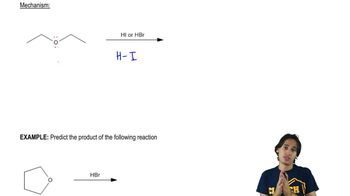
How to predict the products of Ether Cleavage.
Nucleophilic Substitution Reactions
Nucleophilic substitution reactions involve the replacement of a leaving group in a molecule by a nucleophile. In the context of ether synthesis, this often occurs through the reaction of an alcohol with an alkyl halide, where the alcohol acts as a nucleophile. Recognizing the mechanisms of these reactions is crucial for modifying conditions to achieve the desired ether product.
추천 영상:
Nucleophiles and Electrophiles can react in Substitution Reactions.
Reaction Conditions
The conditions under which a chemical reaction occurs, including temperature, solvent, and catalysts, significantly influence the reaction pathway and product formation. For ether synthesis, adjusting these conditions can help favor the formation of the desired ether over side products. Understanding how to manipulate these factors is key to successfully modifying the reaction.
추천 영상:
가이드 코스
EAS Reactions of Pyridine Example 1
관련 실천
교과서 질문
1065
views
교과서 질문
Identify the alkene and alcohol partners that could be used to make the following ethers.
(a)
706
views
교과서 질문
Predict the product and show an arrow-pushing mechanism for the first step of the alkoxymercuration reaction.
928
views
교과서 질문
Two different Williamson ether syntheses can be used to make the compound in (a). Show them. The compound in (b), however, can only be made one way. Show it and explain why a second Williamson ether synthesis is not possible.
(a)
992
views
교과서 질문
Draw a reaction coordinate diagram for the acid-catalyzed addition of an alcohol to an alkene. Which step is rate-determining?
718
views
교과서 질문
Starting with hydrogen sulfide, suggest a synthesis of the following thioether that makes use of two different haloalkanes.
886
views