Ch. 14 - Structural Identification 1: Infrared Spectroscopy and Mass Spectrometry
Mullins - Organic Chemistry: A Learner Centered Approach 1st Edition
Mullins1st EditionOrganic Chemistry: A Learner Centered ApproachISBN: 9780137566471당신이 사용하는 게 아니라요?교과서 변경
13장, 문제 68

What ratio of M, M + 2 , M + 4 and would you expect for 1,6-dibromohexane?
Structural formula of 1,6-dibromohexane, showing a six-carbon chain with bromine atoms at each end.

검증된 단계별 안내
1
Understand the concept of isotopic distribution: The problem involves calculating the isotopic distribution of a molecule, specifically 1,6-dibromohexane. Bromine has two stable isotopes, Br-79 and Br-81, which will affect the mass spectrum of the compound.
Identify the molecular formula: 1,6-dibromohexane has the molecular formula C6H12Br2. This means it contains two bromine atoms, which can be either Br-79 or Br-81.
Calculate the possible mass combinations: The molecular ion peak (M) corresponds to the mass of the molecule with both bromine atoms as Br-79. The M+2 peak corresponds to one Br-79 and one Br-81, and the M+4 peak corresponds to both bromine atoms as Br-81.
Determine the relative abundance of isotopes: The natural abundance of Br-79 is approximately 50.7% and Br-81 is approximately 49.3%. Use these percentages to calculate the expected ratio of M, M+2, and M+4 peaks.
Apply the binomial distribution: Use the binomial distribution to calculate the probability of each isotopic combination. For two bromine atoms, the probabilities are: P(M) = (0.507)^2, P(M+2) = 2 * (0.507) * (0.493), and P(M+4) = (0.493)^2. This will give you the expected ratio of the peaks.

비슷한 문제에 대한 검증된 영상 답변:

이 영상 해법은 위 문제에 도움이 된다고 튜터들이 추천한 것입니다.

주요 개념

질문에 올바르게 답하기 위해 반드시 이해해야 하는 핵심 개념들은 다음과 같습니다.

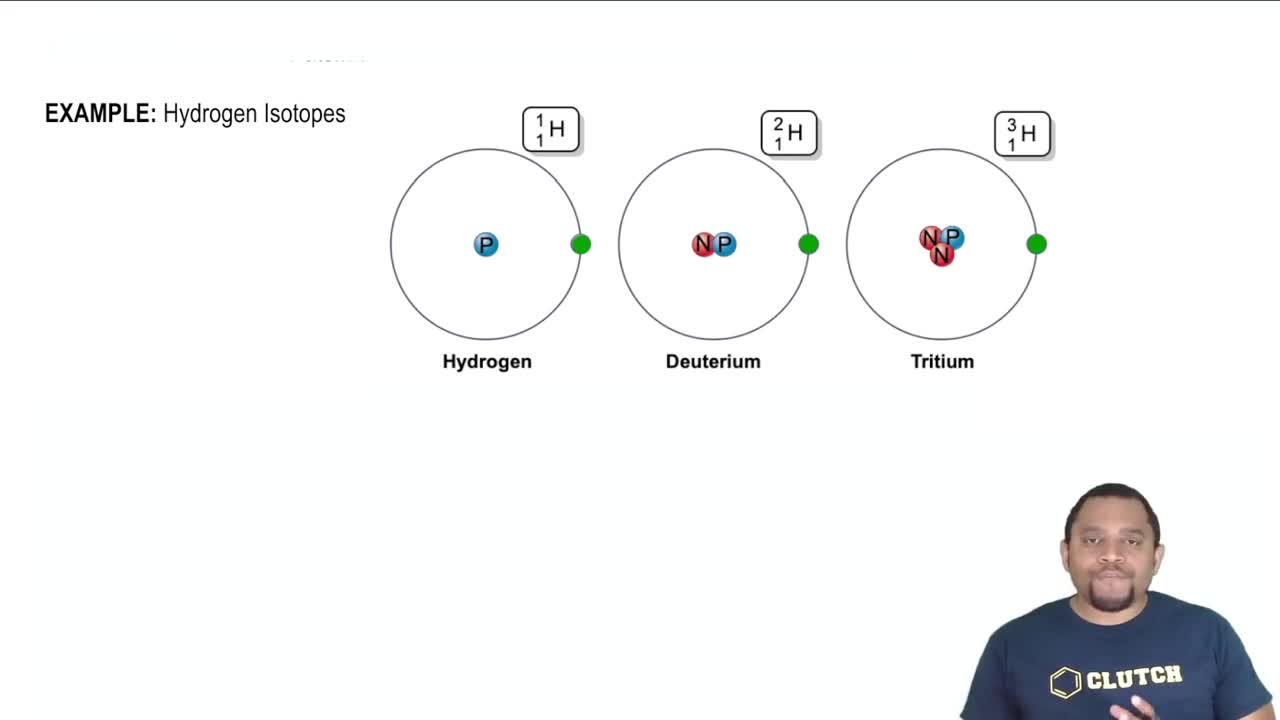
Isotopic Abundance

Isotopic abundance refers to the relative amount of each isotope of an element found in a natural sample. For bromine, the two main isotopes are Br-79 and Br-81, which occur in nearly equal abundance. This isotopic distribution is crucial for predicting the mass spectrum of compounds containing bromine, such as 1,6-dibromohexane.
추천 영상:
03:06
Understanding the hydrogen isotopes.

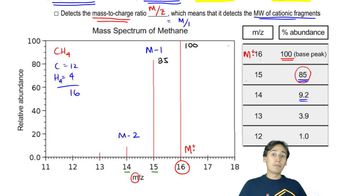
Mass Spectrometry

Mass spectrometry is an analytical technique used to measure the mass-to-charge ratio of ions. It helps in determining the molecular weight and structure of a compound. In the context of 1,6-dibromohexane, mass spectrometry can reveal the presence of isotopic peaks (M, M+2, M+4) due to the different combinations of bromine isotopes in the molecule.
추천 영상:
01:25
How to Read a Mass Spectrum

Molecular Ion Peak

The molecular ion peak (M) in a mass spectrum represents the ionized form of the entire molecule. For 1,6-dibromohexane, the M peak corresponds to the molecule containing two Br-79 isotopes. The M+2 and M+4 peaks arise from combinations of Br-79 and Br-81 isotopes, reflecting the isotopic pattern and helping to deduce the compound's structure.
추천 영상:
가이드 코스
3:39
Metal Ion Catalysis Concept 1