교과서 질문
Draw the ¹³C NMR spectrum you would expect to see for each of the molecules shown.
(a)
1417
views

 Mullins 1st EditionCh. 15 - Structural Identification 2: Nuclear Magnetic Resonance Spectroscopy문제 67b
![Chemical structure of a bicyclo[3.1.0]hexane molecule, featuring a six-membered ring with a three-carbon bridge.](https://static.studychannel.pearsonprd.tech/courses/organic-chemistry/thumbnails/805e7cc2-f5ca-4655-bcd0-861439e09935)
 검증된 단계별 안내
 10:06
10:06
 11:44
11:44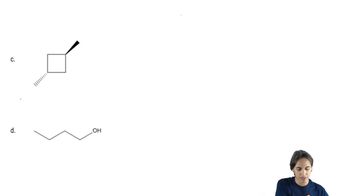 01:10
01:10Draw the ¹³C NMR spectrum you would expect to see for each of the molecules shown.
(a)
A graduate student ran a reaction that produced a mixture of the following two compounds. After painstaking purification, she is able to separate the two compounds. Using ¹H NMR, how can she determine which diastereomer is in which separated sample?
For the molecules in Assessment 15.58, give an approximate chemical shift for each indicated carbon. [The range of correct answers is large here.].
(a)
Assign the peaks in the ¹H NMR spectrum for the molecule shown.
<IMAGE>
For the molecules in Assessment 15.58, give an approximate chemical shift for each indicated carbon. [The range of correct answers is large here.].
(c)
Draw the 13C NMR spectrum you would expect to see for each of the molecules shown.
(c)