Ch. 18 - Nucleophilic Acyl Substitution 1: Carboxylic Acids
Mullins - Organic Chemistry: A Learner Centered Approach 1st Edition
Mullins1st EditionOrganic Chemistry: A Learner Centered ApproachISBN: 9780137566471당신이 사용하는 게 아니라요?교과서 변경
17장, 문제 5e

Calculate the oxidation numbers for the indicated atoms.
(e) Chemical structure of a phenol with an arrow indicating the oxidation number calculation for specific atoms.

검증된 단계별 안내
1
Identify the atom for which you need to calculate the oxidation number. In the image, the arrow points to a carbon atom in the benzene ring.
Understand the general rules for assigning oxidation numbers: typically, hydrogen is +1, oxygen is -2, and carbon can vary depending on its bonding environment.
Consider the bonding environment of the carbon atom in question. In a benzene ring, each carbon is bonded to one hydrogen and two other carbons. The carbon atom in question is also bonded to the carbonyl group.
Apply the rule that in a neutral molecule, the sum of oxidation numbers must equal zero. Calculate the oxidation number of the carbon atom by considering its bonds: it shares electrons with adjacent carbon atoms and hydrogen.
Use the concept that in a covalent bond, electrons are assigned to the more electronegative atom. In the benzene ring, carbon-carbon bonds are shared equally, while the carbon-hydrogen bond assigns electrons to carbon. Calculate the oxidation number based on these assignments.

비슷한 문제에 대한 검증된 영상 답변:

이 영상 해법은 위 문제에 도움이 된다고 튜터들이 추천한 것입니다.

주요 개념

질문에 올바르게 답하기 위해 반드시 이해해야 하는 핵심 개념들은 다음과 같습니다.

Oxidation Number

The oxidation number is a theoretical charge assigned to an atom in a molecule, representing the number of electrons lost or gained by the atom. It helps in understanding electron transfer in redox reactions. For organic compounds, it is calculated by considering the electronegativity of atoms and the bonding environment, with more electronegative atoms assigned negative oxidation states.
추천 영상:
03:40
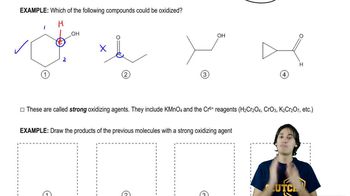
Strong oxidizing agents

Electronegativity

Electronegativity is the tendency of an atom to attract electrons towards itself in a chemical bond. It plays a crucial role in determining oxidation numbers, as more electronegative atoms will attract shared electrons, affecting the oxidation state of the atoms involved. In organic molecules, oxygen is more electronegative than carbon, influencing the oxidation states of adjacent atoms.
추천 영상:
1:47
Electronegativity

Functional Groups in Organic Chemistry

Functional groups are specific groups of atoms within molecules that have characteristic properties and reactivity. In the given structure, the carboxylic acid group (COOH) and the phenyl group (aromatic ring) are present. Understanding these groups helps in predicting the behavior of the molecule, including the distribution of electrons and the calculation of oxidation numbers for specific atoms.
추천 영상:
02:36
Identifying Functional Groups