Ch. 23 - Benzene 1: Aromatic Stability and Substitution Reactions
Mullins - Organic Chemistry: A Learner Centered Approach 1st Edition
Mullins1st EditionOrganic Chemistry: A Learner Centered ApproachISBN: 9780137566471당신이 사용하는 게 아니라요?교과서 변경
22장, 문제 22a

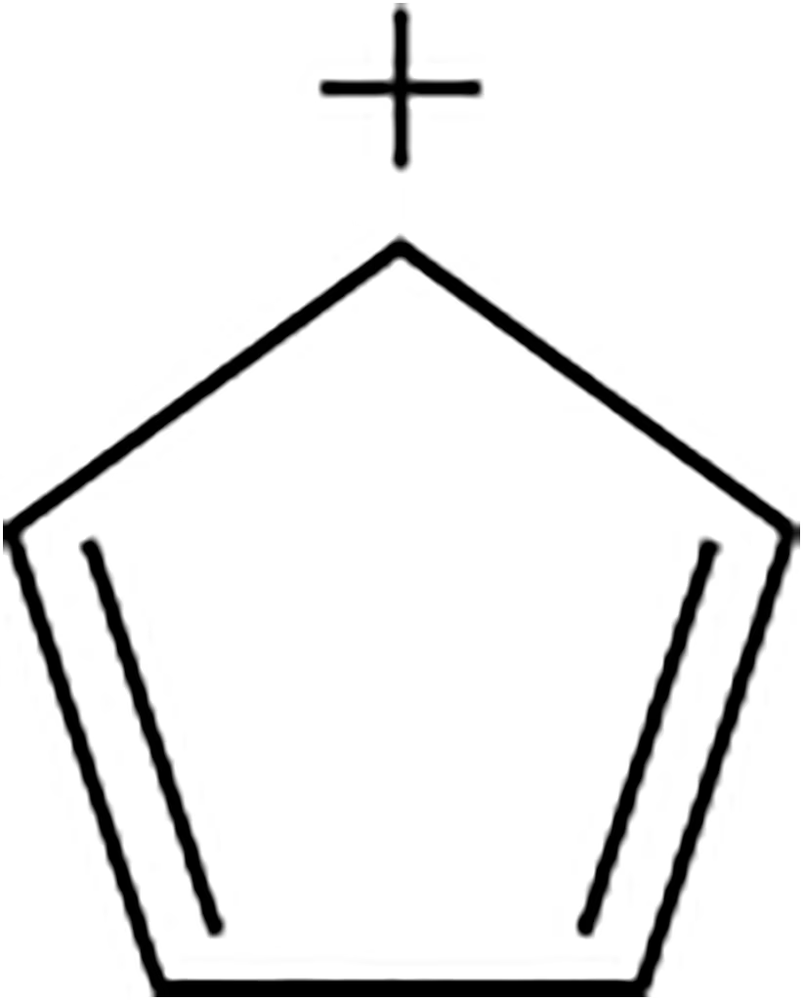
Draw a Frost circle for the cyclopentadienyl cation and compare it to the Frost circle for the cyclopentadienyl anion. What has changed?
Frost circle diagram for cyclopentadienyl cation, showing a pentagon with a positive charge symbol.

검증된 단계별 안내
1
To draw a Frost circle for the cyclopentadienyl cation, start by drawing a circle and inscribing a regular pentagon inside it. The vertices of the pentagon represent the energy levels of the molecular orbitals.
Position the pentagon such that one of its vertices is at the bottom of the circle. This represents the lowest energy molecular orbital.
For the cyclopentadienyl cation, which has 4 π electrons, fill the molecular orbitals starting from the lowest energy level. Each orbital can hold 2 electrons.
Now, compare this to the Frost circle for the cyclopentadienyl anion, which has 6 π electrons. The anion's Frost circle will have the same pentagon, but with 6 electrons filling the orbitals.
The key difference between the cation and anion Frost circles is the number of electrons. The cation has 4 electrons, leading to a different electron configuration and potentially different stability compared to the anion with 6 electrons.

비슷한 문제에 대한 검증된 영상 답변:

이 영상 해법은 위 문제에 도움이 된다고 튜터들이 추천한 것입니다.
영상 길이:
7m

주요 개념

질문에 올바르게 답하기 위해 반드시 이해해야 하는 핵심 개념들은 다음과 같습니다.

Frost Circle

A Frost circle is a graphical representation used to visualize the energy levels of molecular orbitals in cyclic compounds. It helps in determining the stability and electronic configuration of species like cations and anions by plotting the energy levels against the vertices of a polygon, typically a circle. The position of the orbitals indicates their energy, allowing for easy comparison between different species.
추천 영상:
02:56
Inscribed Polygon Method

Cyclopentadienyl Cation and Anion

The cyclopentadienyl cation (C5H5+) and anion (C5H5-) are derived from cyclopentadiene by losing or gaining a hydrogen atom, respectively. The cation is electron-deficient and has a positive charge, while the anion is electron-rich and carries a negative charge. These changes in charge significantly affect their stability and reactivity, which can be analyzed through their respective Frost circles.
추천 영상:
가이드 코스
1:06
Anionic Polymerization Concept 4

Molecular Orbital Theory

Molecular Orbital Theory explains how atomic orbitals combine to form molecular orbitals, which can be occupied by electrons. In the context of the cyclopentadienyl cation and anion, this theory helps in understanding how the addition or removal of electrons alters the energy levels and distribution of electrons in the molecular orbitals, influencing the overall stability and properties of the species.
추천 영상:
08:41
Review of Molecular Orbitals