Ch. 4 - Acids and Bases/Electron Flow
Mullins - Organic Chemistry: A Learner Centered Approach 1st Edition
Mullins1st EditionOrganic Chemistry: A Learner Centered ApproachISBN: 9780137566471당신이 사용하는 게 아니라요?교과서 변경
3장, 문제 4.62e5

For the following acid–base pairs, (v) show a mechanism for the reaction;
(e)

검증된 단계별 안내
1
Identify the acid and the base in the given pair. The acid is the species that donates a proton (H+), and the base is the species that accepts a proton.
Draw the Lewis structures of the acid and the base to visualize the electron pairs involved in the reaction.
Use curved arrows to show the movement of electron pairs. The arrow should start from the electron pair on the base and point towards the hydrogen atom of the acid, indicating the formation of a new bond.
Show the breaking of the bond between the hydrogen and the atom it is attached to in the acid. Use a curved arrow starting from the bond and pointing towards the atom that will retain the electrons after the bond is broken.
Write the products of the reaction, showing the conjugate acid and conjugate base formed after the proton transfer.

비슷한 문제에 대한 검증된 영상 답변:

이 영상 해법은 위 문제에 도움이 된다고 튜터들이 추천한 것입니다.
영상 길이:
4m

주요 개념

질문에 올바르게 답하기 위해 반드시 이해해야 하는 핵심 개념들은 다음과 같습니다.

Acid-Base Theory

Acid-base theory explains the behavior of acids and bases in chemical reactions. According to the Brønsted-Lowry theory, acids are proton donors while bases are proton acceptors. Understanding this concept is crucial for predicting the direction of acid-base reactions and identifying the conjugate acid-base pairs involved.
추천 영상:
02:49
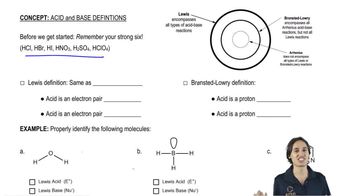
The Lewis definition of acids and bases.

Reaction Mechanism

A reaction mechanism details the step-by-step process by which reactants transform into products. It includes the breaking and forming of bonds, the movement of electrons, and the intermediates formed during the reaction. Knowing the mechanism helps in understanding how the acid-base pairs interact and the specific pathways taken during the reaction.
추천 영상:
02:16
Heck Reaction Mechanism

Conjugate Acid-Base Pairs

Conjugate acid-base pairs consist of two species that differ by the presence or absence of a proton (H+). When an acid donates a proton, it becomes its conjugate base, and when a base accepts a proton, it becomes its conjugate acid. Recognizing these pairs is essential for analyzing the equilibrium of acid-base reactions and predicting the products formed.
추천 영상:
가이드 코스
2:56
Base Pairing Concept 1