Ch. 4 - Acids and Bases/Electron Flow
Mullins - Organic Chemistry: A Learner Centered Approach 1st Edition
Mullins1st EditionOrganic Chemistry: A Learner Centered ApproachISBN: 9780137566471당신이 사용하는 게 아니라요?교과서 변경
3장, 문제 55b

Identify the nucleophile and the electrophile in each of the following reactions.
(b) Chemical reaction diagram showing nucleophile and electrophile with arrows indicating electron movement.

검증된 단계별 안내
1
Step 1: Understand the definitions of nucleophile and electrophile. A nucleophile is a species that donates a pair of electrons to form a new covalent bond, often rich in electron density (e.g., lone pairs, π bonds, or negative charges). An electrophile is a species that accepts a pair of electrons to form a new covalent bond, often electron-deficient (e.g., positive charges, partial positive charges, or empty orbitals).
Step 2: Analyze the reaction provided. Look at the reactants and identify which species has electron-rich regions (potential nucleophile) and which species has electron-deficient regions (potential electrophile).
Step 3: Examine functional groups or charges. For example, if one reactant has a lone pair of electrons or a negative charge, it is likely the nucleophile. If another reactant has a positive charge, partial positive charge, or an electron-deficient atom, it is likely the electrophile.
Step 4: Consider the mechanism of the reaction. Determine which species initiates the reaction by donating electrons (nucleophile) and which species accepts those electrons (electrophile).
Step 5: Assign the roles. Clearly label the nucleophile and electrophile based on the analysis. For example, if a hydroxide ion (OH⁻) reacts with a carbonyl compound, the hydroxide ion is the nucleophile, and the carbonyl carbon (C=O) is the electrophile due to its partial positive charge on the carbon.

비슷한 문제에 대한 검증된 영상 답변:

이 영상 해법은 위 문제에 도움이 된다고 튜터들이 추천한 것입니다.
영상 길이:
3m

주요 개념

질문에 올바르게 답하기 위해 반드시 이해해야 하는 핵심 개념들은 다음과 같습니다.

Nucleophile

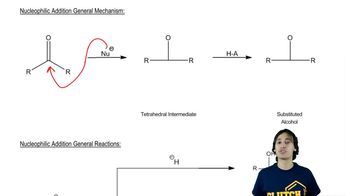
A nucleophile is a species that donates an electron pair to form a chemical bond in a reaction. Nucleophiles are typically negatively charged or neutral molecules with lone pairs of electrons, allowing them to attack positively charged or electron-deficient centers. Understanding the nature of nucleophiles is crucial for predicting reaction mechanisms and outcomes in organic chemistry.
추천 영상:
08:27
Nucleophilic Addition

Electrophile

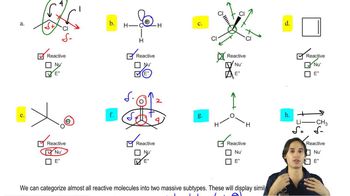
An electrophile is a chemical species that accepts an electron pair from a nucleophile during a reaction. Electrophiles are often positively charged or have a partial positive charge due to electronegative atoms nearby. Recognizing electrophiles is essential for understanding how reactions proceed, as they are the targets for nucleophilic attack.
추천 영상:
03:
Nucleophile or Electrophile

Reaction Mechanism

A reaction mechanism describes the step-by-step process by which reactants transform into products, detailing the movement of electrons and the formation and breaking of bonds. Understanding reaction mechanisms is vital for predicting the behavior of nucleophiles and electrophiles in various reactions, as it provides insight into the intermediates and transition states involved.
추천 영상:
02:16
Heck Reaction Mechanism